Website Design
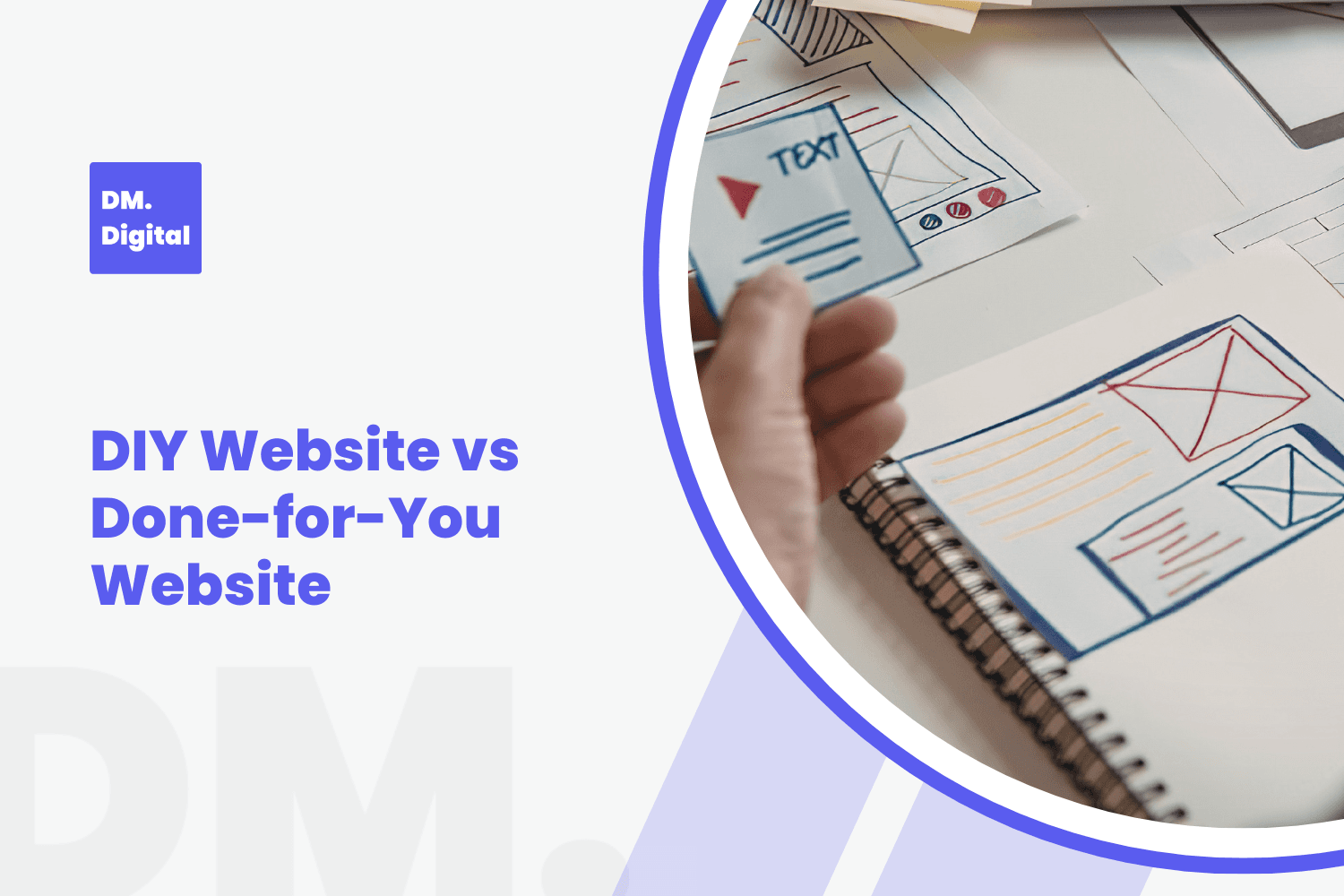
DIY Website vs Done-for-You Website: Which Is Right for a Local Business?
OUR SERVICE AREA
DM. Digital serves businesses across the USA and is open 24/7 for SEO in the USA. We handle Google Business Profile, Local SEO, Website Design, Content Strategy, Analytics & Performance and AI Visibility, measured by the calls and forms they bring in.
Let's get you more clients
Get your free SEO audit. We'll help you get more leads, visibility, and clients for your local business.
Short answer: a DIY website is one you build and keep up yourself on a builder such as Wix, Squarespace or GoDaddy. A done-for-you website is planned, written, built and maintained by a team. DIY costs less money and more of your time. Done-for-you costs more and makes sense once a single new customer is worth enough to pay for the work. The system a site is built on rarely decides whether a local business shows up on Google or in AI answers. What decides it is the pages, the Google Business Profile, the reviews, the links and the work that continues after launch.
Most small businesses already have a site. Clutch reported in August 2025 that 83% of small businesses have a website, up from 64% in 2018, and that 41% of the sites it discussed were made with DIY builders like Wix and Squarespace. The same release split the work between outsourced partners (45%), in-house teams (37%) and owners building their own (8%). So the real decision is not whether to have a website. It is who builds it, who keeps it working, and what you expect it to bring in.
This guide walks through what each option really includes, what it costs over a year and beyond, what Google and AI tools actually look at, what customers judge in the few minutes they spend deciding, and a simple way to work out which option fits your business. Every number below is linked to the study or page it came from.

A DIY website is a site the owner builds and maintains on a website builder. You pick a template, write the copy, choose photos, connect a domain, set up the contact form and keep everything current. Every decision is yours, and so is every hour.
A done-for-you website is a site a team plans, writes, builds and keeps improving for you. The difference that matters most is not the build, it is what happens after launch. A site built once and left alone behaves a lot like a DIY site a year later. A site that someone keeps adding pages to, keeps in line with the Google Business Profile and keeps checking against real search data is a different kind of business asset.
In practice there are four paths, not two:
Paths 1 and 2 are DIY. Path 3 is done-for-you at launch and DIY afterward. Path 4 is done-for-you all the way through. Keep that distinction in mind as you compare prices, because a cheap build and an ongoing program are not the same product.
DIY is cheapest in dollars; professional builds cost more up front; ongoing programs cost the most per month because the work never stops. Here is what the published numbers say.
Website Builder Expert reported in September 2026 that Wix plans run $17 to $159 a month billed annually (Light $17, Core $29, Business $39, Business Elite $159), or $24 to $172 billed monthly. It also noted that the free Wix domain lasts only the first year, after which a .com costs about $21.35 a year, that some Wix apps cost about $3 to $20 a month, and that custom email through Google costs about $6 a month. GoodFirms survey data reported in July 2024 put a basic small business site on a builder like Wix or Squarespace at roughly $50 to $500 a year.
Free plans exist, but they are limited. Wix's own article from July 2026 says its free plan uses a non-customizable wixsite.com address, shows Wix branding and ads, and has no way to take payments. GoDaddy's help center lists a paid Airo plan as a requirement to connect a custom domain. A business that is serious about being found needs its own domain, so plan on a paid tier.
In GoodFirms' survey of 200+ web design agencies and freelancers, updated May 2026, a basic-feature website averaged about $3,200, and professionals took an average of two months to build one. Clutch's Web Design Pricing Guide, updated September 2026, says most web design projects on its platform cost less than $10,000, lists typical agency pricing of $2,000 to $100,000 depending on size and features, and puts shortlisted firms at around $100 to $149 an hour versus $25 to $49 an hour for firms working on builders like Wix, Squarespace or WordPress. The same GoodFirms 2024 data put annual maintenance for a small business site at $250 to $1,000.
Using only the published figures above, here is how the first year can look. These are ranges from the cited sources, not quotes for your business.
| Path | Money in year one | Who does the ongoing work |
|---|---|---|
| DIY builder (paid Wix plan, annual) | About $204 to $1,908 for the plan, plus domain after year one, apps and email | You |
| One-time professional build | About $3,200 on average for a basic site (GoodFirms), plus $250 to $1,000 a year to maintain | You, after handover |
| Managed program (DM. Digital) | Engagements start at a $5,000 per month budget, covering the website and the ongoing SEO and AI visibility work | The agency |
The table makes DIY look like an easy win. It leaves out the biggest line item, which is your time.
BrightLocal's 2025 survey of 778 US small business owners and managers found 54% manage marketing themselves, with no employee or internal team handling it, and 36% said cost is holding them back from investing in marketing channels. Constant Contact's 2025 research with Ascend2, a survey of 2,500 small business decision-makers in four countries, found 42% have less than one hour a day for marketing, and only 18% felt very confident in their marketing, down from 27% the year before. Fiverr's 2025 survey of its small business users found 70% of owners spend less than five hours a week on marketing.
A website is not a one-weekend project. Pages need writing, photos need replacing, hours and services change, and every change has to match your Google Business Profile. When an owner with less than an hour a day is also the web team, the site usually stops changing a few months after launch. That is the real cost of DIY: not the subscription, but the leads a stale site never brings in.

Not by itself. Google's John Mueller said on Ask Googlebot in 2022 that "Google systems don't focus on how the page was created" and that all mainstream systems can create pages that work well in search.
Google measures real-world page experience through Core Web Vitals. Google's documentation sets the targets: the main content should load within 2.5 seconds, the page should respond to taps within 200 milliseconds, and the layout should not jump around. Field data from Google's report, pulled by WebHosting.Today for June 2026, showed mobile pass rates of 80.1% for Wix, 76.5% for Shopify, 73.1% for WordPress.com and 70.1% for Squarespace. The HTTP Archive Web Almanac 2025 found 85% of mobile Duda sites, 74% of Wix sites and 45% of WordPress sites with good Core Web Vitals. A modern builder can be fast. A neglected WordPress site often is not.
Speed matters, but only at the margin. Google's page experience documentation says Core Web Vitals are used by its ranking systems, but "there is no single signal" and Google "always seeks to show the most relevant content, even if the page experience is sub-par." A fast site with thin content still loses to a slower site that answers the search better.
For local searches, Google's own help page explains that results are based mainly on relevance, distance and prominence, and that "businesses with complete and accurate info are more likely to show up in local search results." In practice, sites that rank for many local searches tend to share a few things, none of which depend on the builder:
A template gives you a homepage and a handful of pages. It does not write the service pages, build the profile, earn the reviews or get the links. That is the work most DIY sites never get.
Ahrefs' analysis of Search Console data from August 2025 found the top 10 Google results received about 97% of desktop clicks and the second page received only 1.77%. Advanced Web Ranking's July 2026 data for Google US put the position 1 click rate at 35.74% on mobile and 20.02% on desktop, falling to 3.89% at position 3 on desktop. On results pages with an AI Overview, desktop position 1 earned 9.69%. A site sitting on page three is close to invisible no matter how good it looks, and even a first-page site needs to be near the top or cited in the AI answer to get real clicks.
AI tools are now part of how customers find local businesses, and they lean heavily on information the business itself controls.
Adoption is real. Pew Research Center's February 2026 survey of 5,119 US adults found 49% use AI chatbots and 42% use them to search for information. BrightLocal's Local Consumer Review Survey 2026 found 45% of consumers used AI tools for local business recommendations, making AI the third most used tool behind Google and Facebook.
People still check before they call. Yext's 2026 Consumer Search Behaviors Report found 47% of US adults used AI for local search in the past month and 53% of them then checked Google or Bing before acting. DreamHost's 2026 Local Business Trust Index found that after an AI recommendation, 45% search Google and 34% go straight to the business website.
The website is one of the main things AI tools read. Yext's analysis of 6.8 million citations from ChatGPT, Gemini and Perplexity in July and August 2025 found websites made up 44% of sources and listings 42%, and that 86% of citations came from sources the brand owns or manages, such as websites, listings and reviews.
What this means for the DIY question: AI visibility is not a feature you switch on in a builder. It comes from consistent, specific, well-structured information across your site, your Google Business Profile, your listings and your reviews, kept current over time. That is ongoing work, which is exactly where most DIY sites stall.
Ready to Grow Your Local Business?
DM. Digital helps local service businesses dominate Google with custom-built websites.
Customers decide quickly, compare few options and look for clear information, reviews and pricing.
BrightLocal's 2026 consumer research found 75% of consumers decide which local business to use in under 30 minutes, 72% look at three or fewer businesses before deciding, and the top reasons for choosing one to contact were clear or complete information (32%), the best or most reviews (30%) and clear pricing (29%). BrightLocal's Consumer Search Behavior 2026 study found 73% did their most recent local search on a phone.
The site's look and accuracy still count. In DreamHost's 2026 survey of 1,201 US adults, 69% said a website is essential for a local business to be credible, 60% said an outdated-looking website hurts their view of a business, 67% said clear contact information builds trust, 51% pointed to a secure HTTPS site and 47% to real photos of the team or location instead of stock images. The top frustrations were outdated or inaccurate information (34%) and hard-to-find information (23%).
Wrong information is expensive. A Data Axle survey published April 2026 found 66% of US consumers have visited or tried to visit a business only to find its online information was wrong. A DIY site can meet every one of these standards on launch day. The question is whether anyone keeps it that way.
When we audit sites owners built themselves, the same problems come up again and again, and Google's and Nielsen Norman Group's guidance explains why each one matters:
None of these require a developer to fix. They require someone paying attention, every month.
Whoever builds it, a local business website that earns calls needs the same core pieces. Use this as a checklist for a DIY site or as a standard to hold a hired team to.
A builder can host all of this. The hard part is writing it well, making each page genuinely useful and keeping it accurate as the business changes.
A website is only as good as its least accurate page, and keeping it accurate is a monthly job.
Google is direct about why this matters for local search: if your information is not accurate, your Business Profile "might not show up for relevant searches in your area." Customers notice too. BrightLocal's 2023 Local Business Discovery and Trust Report found 62% of consumers would avoid a business that had incorrect information online.
A simple monthly routine covers most of it:
This routine takes an hour or two a month if nothing goes wrong. The bigger work, writing new service and area pages, earning reviews and links and keeping AI tools fed with accurate information, takes far more. That is where the decision between DIY and done-for-you is really made.
Running a website also means owning its security and accessibility, whether or not you think about them.
Hosted builders handle most security updates for you. Self-managed sites do not. Patchstack's State of WordPress Security in 2026 counted 11,334 new vulnerabilities in the WordPress ecosystem in 2025, up 42% from 2024, and most of them came from plugins rather than WordPress itself. Those numbers describe the whole ecosystem, not a single well-maintained site, but they explain why a WordPress site nobody updates is a risk. The FTC's plain advice applies to any business: delaying updates "gives hackers time to access your information - even when a patch is out there."
Accessibility affects real customers and creates real legal exposure. The CDC says more than 1 in 4 US adults have some type of disability. The WebAIM Million 2026 report found detectable accessibility failures on 95.9% of the top one million home pages, with low-contrast text on 83.9% and missing image descriptions on 53.1%. Seyfarth Shaw counted 3,117 federal website accessibility lawsuits in 2025, up 27% from 2024.
Quick fixes do not always work. In April 2025 the FTC finalized an order requiring the maker of the accessiBe widget to pay $1 million and barring claims that its automated tool can make any website compliant without evidence. Readable contrast, descriptive image text, labeled form fields and buttons that work with a keyboard have to be built into the site itself. On a DIY site, that is one more thing the owner has to check.

Ready to Grow Your Local Business?
DM. Digital helps local service businesses dominate Google with custom-built websites.
The right choice depends mostly on what one new customer is worth to you and how many of them better visibility could bring in. You do not need anyone's statistics for this part. You need your own numbers.
A simple way to think about it is this formula: monthly value from search = the number of people searching for your services in your area, times the share who click on you, times the share who call or book, times the share of calls you answer, times the share that become jobs, times your average job value. It is a framework, not a prediction. Every input should be your own data or a named source.
Two published reference points help put it in context. WordStream's 2026 benchmarks across 13,474 US Google Ads campaigns put the median cost per lead at $66.69 overall, $131.63 for attorneys and legal services, $90.92 for home and home improvement and $72.97 for dentists. That is roughly what a lead costs when you buy it through ads. And LocaliQ's 2026 search ad benchmarks put the average cost per click at $9.87 for attorneys and legal services and $8.00 for dentists.
Run your own numbers like this, using clearly hypothetical inputs only as an illustration: if one new client is worth $3,000 to your practice and better visibility brings in three extra clients a month, that is $9,000 a month in new revenue. If one new client is worth $150, the same three clients are worth $450. The first business can justify a serious ongoing program. The second probably should start with a well-made DIY site and grow into more.
Do not forget the phone. Answering is part of the math. Invoca's July 2026 analysis of more than 70 million calls found 56% of calls to businesses reached a person and only 36% of businesses asked the caller for the sale or appointment. No website fixes a phone nobody answers.
The same website decision looks very different for a law firm, a dental practice and a plumbing company, because the value of a lead and the cost of missing one are different.
Leads are expensive to buy and valuable to win. WordStream's 2026 benchmarks put the median cost per lead from Google Ads at $131.63 for attorneys and legal services, the highest of the categories it lists. Missing calls is common too: CallRail's January 2025 report on 1.1 million conversations found missed call rates of 28% in legal. For these businesses, a site that ranks for specific practice areas and answers real client questions is worth a serious ongoing investment, and every page also has to meet professional advertising rules, which is one more reason not to leave it to a template.
Patients research carefully and compare reviews. The same CallRail report found missed call rates of 32% in healthcare, and WordStream put the median cost per lead at $72.97 for dentists and $40.04 for physicians and surgeons. Health topics are also held to a higher standard by Google and AI tools, so content written and reviewed by qualified people, with clear credentials on the page, matters more here than almost anywhere else. A DIY site can work for a single provider just starting out. A growing practice with several services and locations usually outgrows it quickly.
Calls drive almost everything, and job values range widely. HomeAdvisor, updated June 2026, puts an HVAC replacement at about $7,500 on average, while Angi, updated March 2026, puts a typical plumbing repair at about $341. LocaliQ's home services benchmarks put the median cost per lead from search ads at $129.02 for plumbing, $93.69 for electricians and $228.15 for roofing and gutters. A trade business that mostly does small repairs may do fine with a solid DIY site and a strong Google Business Profile. One that sells replacements, installations or emergency service across a wide area usually needs dozens of service and area pages, a constant stream of reviews and fast, tappable contact on every page, which is a lot of ongoing work.
If you are in your first year, the honest advice is usually to start simple: a clean DIY site on your own domain, a complete Google Business Profile and a habit of asking every customer for a review. Spend money on visibility once you know which services earn the most and what a customer is worth to you.
Several popular beliefs about websites and rankings are simply wrong, and they lead owners to spend time or money in the wrong place. Google's own SEO Starter Guide, last updated December 2025, clears up several of them:
Knowing these saves money. A DIY owner can stop worrying about the wrong things, and anyone hiring help can spot a pitch built on myths.
DIY makes sense when you are early, your work comes mostly from referrals, one customer is worth relatively little, and you actually have the hours.
If that is you, here is how to do DIY well: get your own domain on a paid plan, write one page per main service, list your name, address and phone exactly as they appear on your Google Business Profile, use real photos, put a tappable phone number in the header, keep the contact form short, connect Search Console and check it once a month, and keep hours and services current. Ask every happy customer for a review and reply to every review you get. BrightLocal's 2026 review survey found 89% of consumers expect owners to respond to reviews and 74% focus on reviews from the last three months.
Ready to Grow Your Local Business?
DM. Digital helps local service businesses dominate Google with custom-built websites.
Done-for-you is the better choice when each customer is worth a lot, competition is real and the website has to work with everything else you do online.
Ask about results, ownership, reporting and exit terms before you sign, and walk away from anyone who guarantees rankings.
Google publishes its own buyer's guide. Its "Do you need an SEO?" page, updated June 2026, suggests asking for examples of previous work, what results to expect and in what timeframe, and how success is measured. It also states plainly: "No one can guarantee a #1 ranking on Google," and warns against anyone claiming a special relationship with Google.
Use this checklist:
Agency relationships fail when expectations are vague. In the vcita inTandem 2025 SMB Marketing Report, a survey of 500 US business owners, 40% of small businesses that outsource marketing churned, and 60% of those who left or cut back cited inadequate return on investment. Clear reporting and clear ownership prevent most of that.

At DM. Digital, the website is never a separate one-time project. It is part of one monthly package that covers the site and everything around it.
DM. Digital is an SEO and AI visibility agency that helps local businesses anywhere in the United States get found and get leads on Google Search, Google Maps and AI tools such as ChatGPT, Google AI Overviews and AI Mode, Gemini, Perplexity and Copilot. The package covers:
How it works for you:
We do not promise rankings, AI placement or lead numbers, because no honest agency can. What we can show is how the work moves the numbers we report. For example, for a garage door company in Orange County, California, domain rating rose from 9 to 13 and Google AI Overview mentions from 1 to 12 between March and September 2026, according to our monthly client reports. You can see more anonymized results by business type and region on our case studies page.
If you are not ready for an agency yet, Grow Local, from the same company, is a $99 per month self-serve website builder for owners who want to start on their own and upgrade later.
Choose DIY when your time is cheaper than outside help, your work comes mostly from referrals and one new customer is worth relatively little. Do it well: your own domain, a page per service, real photos, a tappable phone number, a matching Google Business Profile and a steady flow of reviews. Choose done-for-you when each customer is worth a lot and the website has to work every month alongside your profile, reviews, links and AI visibility. Either way, measure the result in leads, not in how the site looks. If you want to talk through which fits your business, contact DM. Digital and Dan will call you back.
The DM Digital team builds custom websites and runs Local SEO programs for local service businesses across the USA. Articles from the team reflect on-the-ground experience from real client engagements - Google Business Profile work, neighborhood-page strategy, technical SEO, and conversion optimization for service businesses competing in the map pack.
Licensed in Nevada
Last updated on
Why trust DM. Digital?
Founded in 2018, DM. Digital is an SEO Agency serving businesses across the USA. All content is reviewed by our licensed technicians.
Ready to Grow Your Local Business?
DM. Digital helps local service businesses dominate Google with custom-built websites.
A website switch does not have to cost you rankings. Here is how to inventory what works, build a redirect map, protect content, launch safely, change domains or your Google Business Profile address and recover quickly.
The right page count comes from your services and service areas, not a package size. Here are the core pages, how many service and area pages to build, example site maps and a planning method.
A website builder gets you online; local SEO is the ongoing work that gets you found. Here is what that work involves, what owners can handle themselves, when an agency pays off and how to choose one.