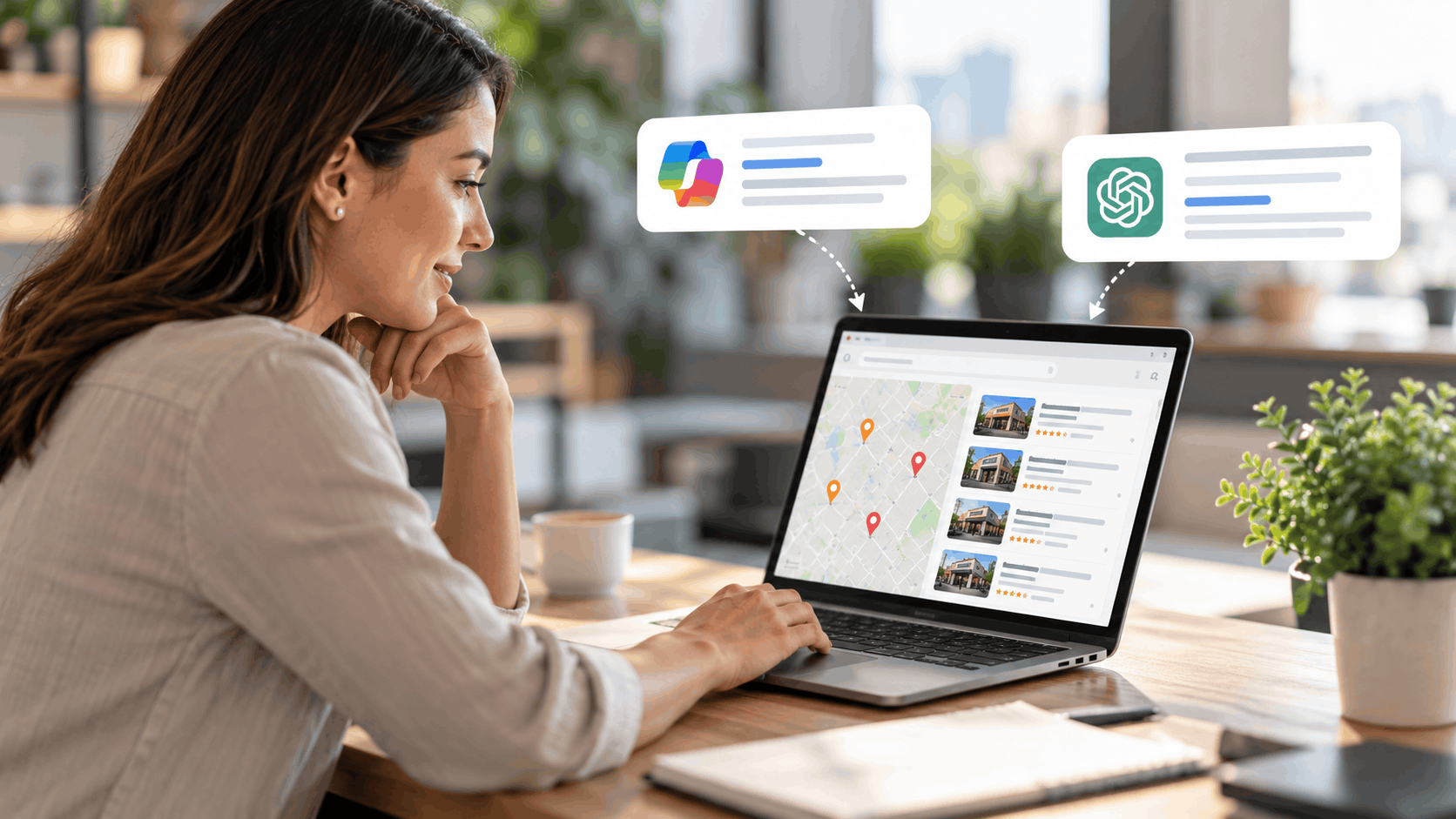
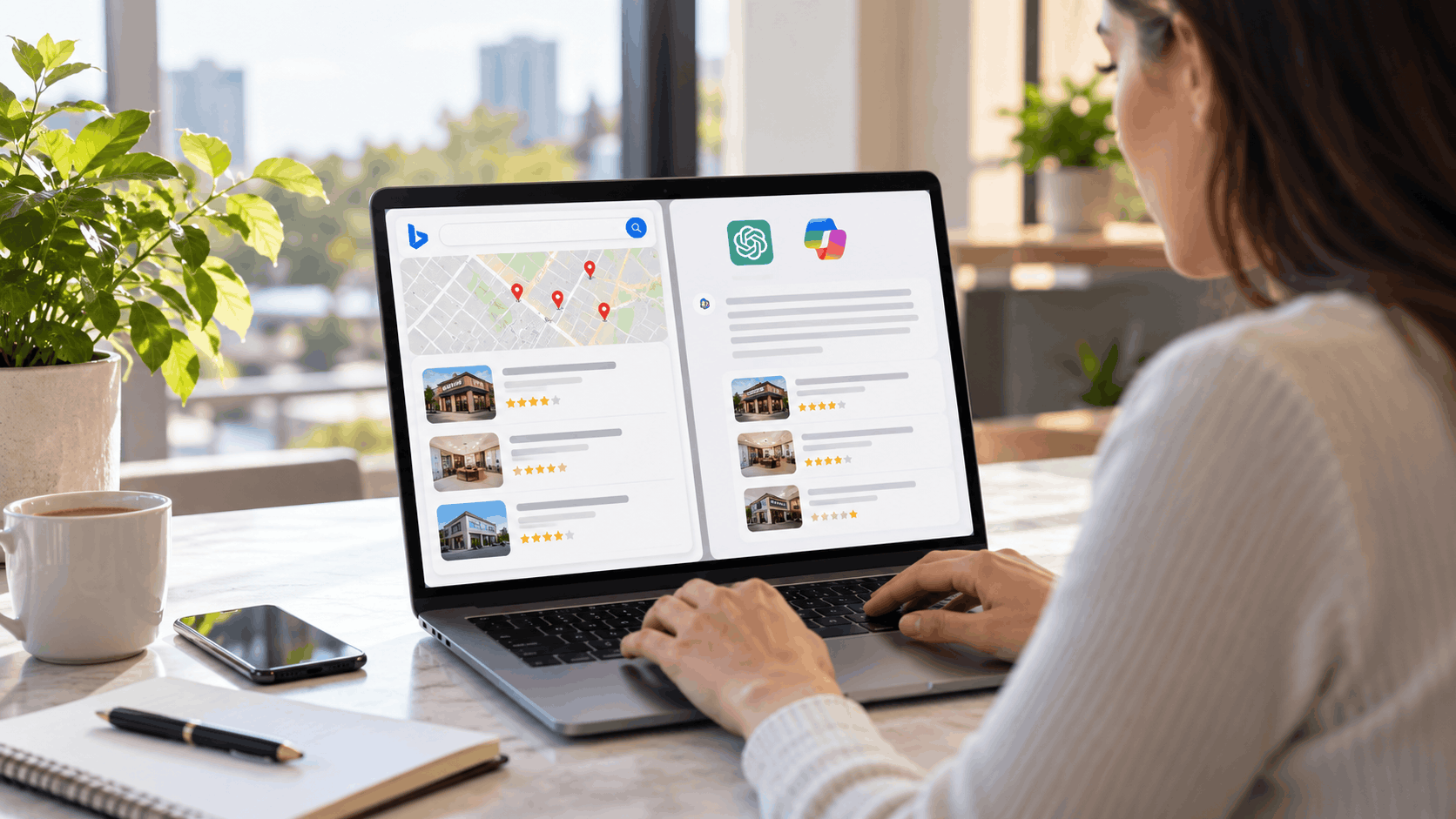
Most local business owners set up their Google listing and stop there. That makes sense given how many people start on Google, but it leaves a gap. AI tools like Microsoft Copilot and ChatGPT pull from a wider picture than Google alone, and Bing sits inside part of that picture.
Bing Places is the free listing platform behind Bing search and Bing Maps. A complete listing there adds another trusted source of facts about a business, and those facts feed the signals AI tools lean on when they answer a local question.

What Bing Places Is and Why It Matters for AI Answers?
Bing Places is Microsoft's free directory for local businesses. It controls how a business shows up in Bing search results and on Bing Maps, the same way Google Business Profile controls how a business shows on Google Search and Google Maps. A listing there is not a direct ticket into an AI answer, but it strengthens the pool of facts that AI tools draw from when someone asks about local services.
Here is a plain comparison of the three main free listing platforms and where each one shows up.
| Platform | Cost | Where listings appear | AI connection |
|---|
| Google Business Profile | Free | Google Search and Google Maps | AI Overviews and AI Mode link to pages already in Google |
| Apple Business | Free, with optional paid add-ons | Apple Maps, Safari, Spotlight | Place cards across Apple surfaces |
| Bing Places | Free | Bing Search and Bing Maps | Deeper Copilot work described as future, not live |
The common thread is simple. Complete and accurate information on every platform gives systems a consistent story to trust, and that same consistency helps the wider search picture AI tools read from.
What Bing Places Does for a Local Business
Bing Places is the free listing that puts a business on Bing search results and Bing Maps. Someone searching for a plumber or a law firm on Bing sees these listings, and a claimed, filled-out profile stands a better chance of showing the right hours, phone number and services than an unclaimed one.
Search Engine Journal reported in October 2025 that Bing Places moved to bing.com/forbusiness. The relaunch kept the platform free and brought in better tools for managing listings, including the ability to import Google Business Profile data so owners do not have to type everything twice.
For a small business, the value is coverage. A listing here reaches people who use Bing as their default search, and it adds another verified source of name, address, phone and hours to the open web.
The platform now shows listings across Bing search and Bing Maps from one place. Keeping that listing accurate means the facts a customer finds on Bing match what they find on Google, which builds trust with both people and the systems that read business data. Our local SEO team treats Bing as part of the same listing foundation, not an afterthought.
How Bing Places Connects to Microsoft Copilot
This is where honesty matters. Microsoft describes deeper Copilot integration with Bing Places as future work. That means no one should claim Copilot pulls directly from Bing Places today. Anyone telling a business owner otherwise is getting ahead of what Microsoft has actually said.
What is true today is narrower and still useful. Microsoft has said its workplace Copilot can pull information from Bing search to compose answers when web search is turned on. Bing search and Bing Places are different things, but a strong Bing presence contributes to the open web that Bing search indexes.
So the practical takeaway is to build the listing now because it strengthens a business's footprint on Bing, and to treat any direct Copilot connection as something that may come later rather than a current fact. Setting that expectation keeps planning grounded.
The sensible move is to get the listing complete and verified, keep it current, and let the wider benefit follow as Microsoft rolls out more connections over time. There is no downside to a free, accurate listing, and getting it done now means the work is already in place whenever Copilot features expand.
Where ChatGPT Fits In
ChatGPT does not draw from Bing Places in any stated way, so it helps to understand what it actually does. OpenAI's ChatGPT search help page, updated September 2026, says ChatGPT can use a user's rough location for local results and sometimes works with other search providers. On phones it may show a map, and it uses OpenTable, Resy or Yelp for restaurant bookings.
The same OpenAI guidance is clear that placement is not guaranteed. There is no setting, payment or trick that buys a spot inside a ChatGPT answer. What a business can do is make sure the facts about it are correct and consistent everywhere, so when ChatGPT does search the web, it finds a clear, matching story.
That is why strong, consistent listings matter across every platform. They feed the signals AI tools rely on, like accurate names, addresses, hours and services. A business with a tidy listing on Google, Bing and Apple, plus a clear website, gives these tools fewer reasons to get the facts wrong.
None of this is a guarantee, and it should not be sold as one. It is simply the groundwork that makes a business easier to find and describe correctly, whether a person is on a search engine or inside an AI chat. Our AI visibility work starts from exactly these basics.
How Many People Actually Use These Tools
The effort question comes down to reach. Bing had 9.89% of US search use in September 2026. That is a smaller slice than Google, but it still represents a meaningful number of real searches that a business can show up in for free.
Copilot adds to the case. Microsoft reported 150 million monthly users across the Copilot family on its October 2025 earnings call. That is a large audience interacting with Microsoft's AI tools, and the open web and Bing search sit behind parts of that experience.
Put together, the picture is a Microsoft ecosystem with real usage, where a free listing and a well-structured website cost nothing but time to set up. The return is not guaranteed placement, but it is presence in a channel many owners skip entirely.
Because competitors often ignore Bing, a complete and accurate listing can be a quiet advantage. The business that shows up correctly when a Bing user searches, while rivals show stale or missing data, wins that moment. A small effort here goes further than its search share alone suggests.
How to Claim and Verify Your Bing Places Listing?
Claiming a Bing Places listing is something an owner can do without a developer. The steps are straightforward, the platform is free, and most of the work is confirming facts that already exist about the business. Below is the practical path from start to a verified, published listing.
Platform menus change over time, so treat these steps as the current shape of the process and confirm the exact wording with Bing as you go. The core idea stays the same: claim the listing, prove the business is yours, and fill it out completely.
Claim or Create the Listing
The starting point is bing.com/forbusiness, where Microsoft lets an owner claim an existing listing or create a new one. Bing Places for Business is free, and Microsoft's own guidance is to use it to claim or update a business listing. If the business already appears on Bing, claiming the existing entry avoids creating a duplicate.
The October 2025 relaunch added tools that make management easier. Bulk editing helps businesses with more than one location update details at once. A recommendation tool points owners toward fields worth completing, which is handy for anyone who is not sure what to fill in first.
When creating a listing from scratch, an owner enters the business name, address, phone and category, then moves into verification. Accuracy at this stage matters because these core details carry through everything else and need to match the business's other listings.
Take the time to complete every field the platform offers rather than stopping at the minimum. A fuller listing gives both Bing and the people searching it a clearer, more trustworthy picture of the business.
Import From Google to Save Time
Many owners already have a verified Google Business Profile, and Bing lets them reuse that work. BrightLocal, updated July 2025, notes that importing Google Business Profile data skips Bing's verification when the Google listings are already verified. That turns a multi-step setup into a near one-click move for qualifying businesses.
The catch is in the word qualifying. The shortcut applies when the Google listings are already verified under the same ownership. If a Google profile is unverified, the import still saves typing, but Bing will likely still run its own verification before the listing goes fully live.
Importing also helps consistency, since the imported name, address, phone and hours start out matching Google exactly. That alignment is one of the signals systems use to trust a business's data, so starting from a clean Google profile pays off twice.
After importing, it is worth reviewing every field rather than assuming the transfer was perfect. Categories, hours and photos should all be checked and corrected so the Bing listing is as complete and current as the Google one it came from.
Verification Methods and Timelines
Verification proves the business belongs to the person claiming it. For single locations, Bing assigns the method, which may be phone, website, email or postcard. The owner does not pick freely; Bing chooses based on the business and the information available.
The postcard route takes the longest, with Microsoft citing roughly 5 to 6 business days for that path. Once a listing is verified and published, changes may take 7 to 14 days to appear. Those windows are normal, so an owner should make edits ahead of time rather than expecting instant updates.
Because the method is assigned, it helps to have the business phone, website and email ready so whichever path Bing picks can be completed quickly. A phone or email verification clears far faster than waiting on a mailed postcard.
Verification steps and timelines can shift as Microsoft updates the platform, so confirm the current process with Bing when claiming. Treat the figures here as the recent shape of things rather than a fixed promise.
Verify Your Website in Bing Webmaster Tools
Verifying the listing is one job. Verifying the website is a separate one, done through Bing Webmaster Tools, and it unlocks data worth having. This step connects a business's actual website to Bing's reporting so an owner can see how Bing treats their pages.
The standout feature is the AI Performance report, in public preview since February 2026. It shows how often a site's pages are cited in Copilot and Bing AI answers. That is a rare window into AI visibility, since most tools give no such view, and it turns a guessing game into something measurable.
Setting up Bing Webmaster Tools is a technical task, usually a small amount of code or a file added to the site, or verification through an existing Google Search Console connection. A web person can handle it quickly, and our analytics and reporting team often sets this up alongside Google's tools.
Once verified, the website and the listing work together. The listing carries the business facts, and Webmaster Tools shows how the site performs in Bing search and in Bing's AI answers, giving a fuller read on visibility across Microsoft's ecosystem.
DM. Digital helps local service businesses dominate Google with custom-built websites.
A claimed listing with blank fields does little. Google's guidance across its help pages is consistent: businesses with complete and accurate information are more likely to show up in local results. The same principle holds on Bing, and the same complete data feeds the wider picture AI tools read from.
The fields that matter most are the basics, and getting them right across every platform is what builds trust. Below is how to handle each part of the listing so both search engines and AI tools get a clear read.
Keep Name, Address and Phone the Same Everywhere
Consistency is the single most useful habit here. The business name, address, phone, hours and categories should match across Bing, Google and Apple. When those details line up, systems treat the data as reliable; when they conflict, confidence drops and the business may show stale or wrong information.
Use the real-world business name as it appears on signage and branding. Google's rules are clear that extra words in the name are not permitted and can lead to suspension, and that same discipline keeps a business clean across platforms. A name stuffed with services or a city is a problem, not an advantage.
The address and phone should be exact and under the business's own control. A precise street address with no remote P.O. box, and a local phone number the business actually answers, give both customers and systems something dependable to work with.
When these details shift, such as a move or a new phone number, update every listing together. A mismatch between Bing and Google is exactly the kind of inconsistency that erodes the trust an AI tool needs to describe a business correctly. Our citation management work keeps these details aligned across the web.
Hours, Categories and Contact Details
Hours are a field customers actually act on, so keeping regular and holiday hours current matters. A listing that says open when the door is locked frustrates customers and sends mixed signals to search systems. Bing recommends keeping hours and contact details current for this reason.
Categories tell the platform what the business is. Choosing accurate categories, led by the one that best completes the idea of what this business is, helps the listing surface for the right searches. The primary category does the heaviest lifting, so it should be the most precise match available.
Contact details round out the picture. A working phone, a correct website address and an email that reaches the business all give customers ways to connect and give systems more verified facts to anchor on.
Holiday hours deserve special attention because they change through the year. Setting special hours ahead of a holiday prevents the listing from showing the wrong status at exactly the moment a customer is deciding whether to visit.
Real Photos, Not Stock
Photos show people what a business actually offers. Google suggests photos and videos to show customers what you offer, and real images of the storefront, team, work and products do that far better than generic stock pictures. Stock imagery tends to look hollow and tells a customer nothing specific.
Real photos build a sense of what to expect before someone ever calls. A plumbing company's own trucks and completed jobs, or a clinic's actual waiting room, read as genuine in a way catalog images never do.
It is worth being clear about what photos do and do not do. They help customers understand a business and can make a listing more appealing, but no one should promise that adding photos lifts rankings. Photo ranking tests are small and mixed, so treat images as a trust and clarity tool, not a ranking lever.
Keep photos reasonably current and sharp. Clear, well-lit images that show the real business give both people and the systems reading the listing an honest look at what the business is.
Using Real-Time Status Updates
The October 2025 relaunch added real-time status updates to Bing Places. This feature lets owners signal current status and keep listing information fresh, which matters when details change often or on short notice.
Fresh information helps on two fronts. Customers get accurate details in the moment, and the platform sees an actively maintained listing rather than one set up once and forgotten. An active listing reads as a cared-for business.
Using the feature is a habit more than a task. An owner who checks in and updates status when something changes keeps the listing aligned with reality, which is the whole point of a listing in the first place.
Pair real-time updates with current hours and contact details, and the Bing listing stays dependable. That reliability is what makes the data worth drawing from, whether a person is searching Bing directly or an AI tool is reading the open web behind the scenes.
Writing a Website That Backs Up Your Listing in AI Answers
A listing is only half the story. AI answers link to normal indexed pages, so the website carries as much weight as the listing when it comes to being found and described correctly. A clear, well-built website gives AI tools something solid to cite.
Google's own guidance for its AI features says normal SEO best practices continue to be relevant, and that special AI files or writing styles are not needed. In other words, a genuinely useful website built on sound basics is the foundation. Here is how to build pages that back up a listing.
Say in Plain Words What You Do and Where
AI answers draw from normal pages, so the website should say in plain words what the business does, which towns it serves and prices or price ranges where that is possible. A visitor, and a tool reading the page, should not have to guess at the service area or what is on offer.
Plain language serves both audiences. Clear sentences like what the business repairs, installs or advises on, and the specific areas it covers, help a person decide and help an AI tool describe the business accurately. Vague marketing copy does neither.
Naming the towns and areas served is part of this. A business that states its service area in plain text gives search and AI tools the geographic facts they need, without forcing anyone to infer coverage from an address alone.
Where prices or ranges can be shared, sharing them helps. Google notes that AI answers link to normal pages, so stating what things roughly cost, where a business is comfortable doing so, gives both customers and tools a clearer, more useful page to work from.
Structure Content the Way Bing Recommends
Microsoft Advertising gave specific advice on October 8, 2025 for content aimed at AI search answers. It recommends descriptive H2s and H3s, answers of one to two sentences that can be lifted cleanly, and not hiding key answers inside tabs, PDFs or images.
Descriptive headings do real work. A heading that states the question or topic plainly helps both readers and AI tools find the relevant part of a page fast. Vague headings bury the answer and make a page harder to read from.
Snippable answers are the other half. When the direct answer to a common question sits in a short, clear sentence right under its heading, it is easy for an AI tool to quote. Burying that answer three paragraphs deep, or inside a graphic, makes it far harder to use.
Avoid trapping important content where crawlers struggle to read it. Key facts belong in plain page text, not locked in a PDF, an image or a tab a visitor has to click. Our content strategy team structures pages with this in mind.
A Dedicated Page for Each Service
A single page per service beats one crowded page that lists everything. Whitespark's 2026 survey of 47 local search experts named a dedicated page for each service as the number one local organic ranking factor. One clear, genuinely useful page per service makes that easy to achieve.
The content on each page has to be real. Google's spam policies treat scaled content abuse and doorway pages as problems, meaning pages that are keyword-swapped clones of each other to rank for similar searches. Each service page must be genuinely useful on its own, not a template with a word changed.
A proper service page explains what the service covers, what the process looks like, what problems it solves and who it is for. That depth helps a customer decide and gives AI tools substantial, specific content to read and cite rather than thin filler.
Building these pages well takes thought, but the payoff is pages that answer real questions and earn their place in search. Our on-page SEO work focuses on making each service page clear, useful and distinct.
Do Not Block AI Search Crawlers
This one is a note for whoever manages the website's technical side. OpenAI's crawler documentation, updated October 2026, states that sites blocking its OAI-SearchBot will not be shown in ChatGPT search answers. Blocking that crawler shuts the door on ChatGPT search visibility entirely.
There is an important distinction between two OpenAI crawlers. Blocking GPTBot only opts a site out of model training, which is a different choice. Blocking OAI-SearchBot is what removes a site from ChatGPT search answers, so the two should not be confused.
Many sites block crawlers without meaning to, through an overly broad robots.txt rule or a security setting. A web person should check that OAI-SearchBot is not blocked if the goal is to appear in ChatGPT search answers.
The fix is usually a quick review of the site's robots.txt file and any firewall rules. Getting this right costs little and removes a silent barrier that can keep a business out of ChatGPT search results no matter how good its content is.

DM. Digital helps local service businesses dominate Google with custom-built websites.
Reviews and Trust Signals That Carry Over to AI
Reviews do more than persuade a human reader. They are a trust signal that search systems weigh, and the same honest signals support the wider picture AI tools read from. A business with real, current reviews gives both people and systems a reason to trust it.
The rules here are strict, and breaking them carries real risk. This section covers why real reviews matter, what the FTC bans, and where a business's own website fits into the citation picture.
Why Real Reviews Matter
Google names review count and ratings as part of prominence, which is one of the main factors in local search alongside relevance and distance. More reviews and positive ratings can help local ranking, so genuine reviews are worth actively asking for.
The honest signals that help in local search feed the broader picture too. A business that steadily earns real reviews builds a record that search and AI tools can read as a sign of a trusted, active business. That record is hard to fake and easy to trust.
Asking for reviews the right way is simple. Google supports asking customers through a review link or QR code, which makes it easy for a happy customer to leave honest feedback. Replying to reviews, including the critical ones, shows a business values feedback.
Consumer expectations back this up. BrightLocal's 2026 survey of 1,002 US adults found 89% expect owners to respond to reviews and 74% look at reviews from the last three months, while 50% are put off by templated replies. Our review generation and response work handles this with personal replies, never templates.
What the FTC Rule Bans
The temptation to shortcut reviews is real, and the law draws a hard line against it. The FTC's rule from August 2024 bans fake reviews, including ones written by AI, paying for reviews of a certain sentiment, and threats to remove bad reviews. Civil penalties are possible for violations.
That makes buying or fabricating reviews a legal risk, not just a policy problem. A business that pays for positive reviews or has AI generate them is exposed to penalties, on top of the damage to trust if customers or platforms catch on.
Google's own rules reinforce this. Incentives for reviews, such as discounts or free goods in exchange for a review, are strictly prohibited. The safe and effective path is asking every customer for honest feedback and making it easy to leave.
The lesson is straightforward. Real reviews from real customers are the only reviews worth having, both because they are legal and because they are the ones that actually build the trust search and AI tools reward. There is no safe shortcut.
Where First-Party Websites Fit
A business's own website turns out to be the heavyweight in AI citations. Yext analyzed 6.8 million citations across ChatGPT, Gemini and Perplexity from July to August 2025 and found first-party websites were the largest single source of AI citations at 44%.
Business listings came in close behind at 42% in the same analysis. Together those two sources account for the large majority of AI citations, which tells a clear story: the website and the listing both matter, and they work as a pair.
That is why neither can be neglected. A strong listing without a useful website leaves one of the two biggest citation sources weak, and a good website with a thin or missing listing does the same. The pair is what gives AI tools reliable sources to cite.
For a business, the practical plan is to invest in both. A clear, well-structured website and complete, consistent listings cover the two sources AI tools lean on most, giving a business its best footing in AI answers without any guarantee being made or needed.
Checking What Copilot and ChatGPT Say About Your Business
Building the listing and website is the work. Checking what AI tools actually say is how an owner catches problems and keeps the facts straight. A simple monitoring routine, run regularly, turns a black box into something manageable.
The goal is to spot wrong facts, fix them at the source, and set honest expectations about what feedback can and cannot do. Here is a routine any owner can follow.
Ask the Tools About Your Business by Name
The simplest check is to ask the tools directly. Query ChatGPT, Copilot and Google about the business by name, and also by service plus town, the way a real customer would. This shows what each tool currently says and whether the facts are right.
Searching by service plus town matters as much as by name. A customer rarely knows a business by name before they find it; they search for a plumber in a specific area or a law firm for a specific need. Checking those queries shows whether the business surfaces at all.
Running these checks on a regular schedule, rather than once, catches changes over time. AI answers shift as sources update, so a monthly look keeps an owner aware of what is being said and whether anything has gone wrong.
Keep a simple record of what each tool says and the date. That history makes it easy to see whether fixes are taking hold and whether a business's presence in AI answers is building or slipping.
Report Wrong Answers and Fix the Source
When a tool gets a fact wrong, there are ways to flag it. In Google AI Overviews, use thumbs down then Report a problem. In ChatGPT, click the thumbs down icon under the response. These signals tell the tool something is off.
Reporting is only part of the fix, though. Feedback is not promised to change an answer, so the more reliable move is to fix wrong facts at the source first. That means correcting the listings and the website that the tools draw from.
If a tool shows the wrong hours or an old address, the real cure is updating those details on Google, Bing, Apple and the website. Once the source is correct, the AI answer has accurate facts to pull the next time it looks.
Think of reporting as a nudge and source correction as the actual repair. Fixing the underlying listings and pages is what gives a lasting result, while feedback alone may or may not move the answer.
Reading the Bing AI Performance Report
Bing offers a rare piece of visibility here. The AI Performance report in Bing Webmaster Tools, in public preview since February 2026, shows how often a site's pages are cited in Copilot and Bing AI answers. That is a direct read on AI visibility few tools provide.
Most of the time, a business cannot see whether AI tools are citing it. This report changes that for Microsoft's ecosystem, turning citation into something an owner can actually track over time rather than guess at.
Reading it regularly shows which pages get cited and which do not. That pattern can point to pages worth improving, since a page that never gets cited may be thin, buried or hard for crawlers to read.
Used alongside the by-name and by-service checks, the report rounds out an owner's view. Our AI citations and mentions work leans on this kind of measurable data rather than guesswork.
Setting Honest Expectations on Timing
Timing is where owners most often get misled. There is no fixed timeline and no guarantee of placement in AI answers. Anyone who promises a date is guessing, because the platforms themselves do not promise one.
Some technical fixes register quickly. Google says changes to a site can take anywhere from several hours to several months to show in search, and AI Overviews and AI Mode draw from that same index, which Google says does not guarantee indexing or serving. OpenAI says placement in ChatGPT search is not guaranteed.
Building the signals AI tools rely on, like reviews, listings and helpful pages, usually takes months of steady work. This is not a switch to flip; it is a foundation to build, and the results come as that foundation strengthens.
Because platforms change their steps and features, confirm current processes with the source as you go. Set the expectation of steady work over months, not a quick win, and the plan stays honest and realistic.
DM. Digital helps local service businesses dominate Google with custom-built websites.
How DM. Digital Handles Bing Places and AI Visibility
Handling listings, a website and AI visibility across several platforms is a lot for a busy owner to manage alone. DM. Digital brings these pieces together as one monthly engagement, with AI visibility running through all of the work rather than sitting off to the side.
The approach is built on the same basics this guide covers: complete listings, a clear website, honest reviews and steady monitoring. The difference is that it is handled as a managed service, with reporting that shows what is happening.
Listings, Website and Content in One Engagement
DM. Digital sells one monthly package rather than one-off projects. It covers the website build and ongoing management, Google Business Profile management, content production, backlinks, citations and press releases. Bing Places and the other listings sit inside this same package.
AI visibility is not a separate add-on. It runs through all five core services, so the website, the listings and the content are each built with AI answers in mind, using the structured, snippable, crawler-friendly approach this guide describes.
Citations are part of the work, which keeps a business's name, address and phone consistent across the platforms AI tools read from. That consistency is one of the signals that helps a business get described correctly, and it is handled rather than left to the owner.
Clients pay one monthly fee and never pay separate vendors. The website, listings, content and links all come through a single engagement, which keeps the whole effort aligned instead of scattered across providers who do not talk to each other.
Reporting Built on Leads
Reporting centers on results an owner cares about. Clients get monthly reports covering leads, traffic, domain rating, backlink totals and AI mentions, plus a live lead dashboard while the engagement is active. The reporting is built on leads, which is what actually matters to a business.
AI mentions are part of that picture. Tracking how often a business is mentioned in AI answers gives a read on AI visibility over time, alongside the more familiar traffic and link metrics. It turns AI visibility from a mystery into something reported on.
The live lead dashboard means an owner does not have to wait for a monthly report to see how things are going. Leads show up as they come in, so the business can see the work translating into contacts.
None of this comes with a promise of specific numbers or placement. The reporting shows what is happening honestly, including leads, traffic and AI mentions, so an owner can judge the work on real data rather than claims. Our reporting work is built around this.
What Clients Keep and the Terms
Ownership stays with the client throughout. Clients keep their own domain, Google Business Profile and Google and email accounts. Leads from the website go straight to the client's own business email, so they keep arriving even after an engagement ends.
The terms are simple and low-pressure. There is no minimum commitment, and either side can end the engagement with 30 days notice. Clients pay one monthly fee and never juggle separate vendor bills.
Engagements start at a budget of $5,000 per month and grow from there. That covers the full package across listings, website, content and links, with AI visibility running through all of it, as one managed service.
For owners who want a low-cost self-serve start, Grow Local at growlocal.build is a $99 per month website builder from the same company, and users can later upgrade to full service. For most local businesses ready for managed work, the full engagement is the direct path.
Getting Started With Your Bing and AI Visibility
A complete, verified Bing Places listing plus a clear website gives a business presence in a channel most owners ignore, and strengthens the signals Copilot and ChatGPT read from. The engagement starts with a conversation: a call or message, a callback from our founder, an audit of where a business stands, then a proposal.
To talk through your listings, website and AI visibility, call (775) 843-8004 or reach out through our contact page. We will run an audit and send a plan built around your business.