Local SEO
Local SEO for Towing: Dispatch Radius, Service Pages, and Call Volume
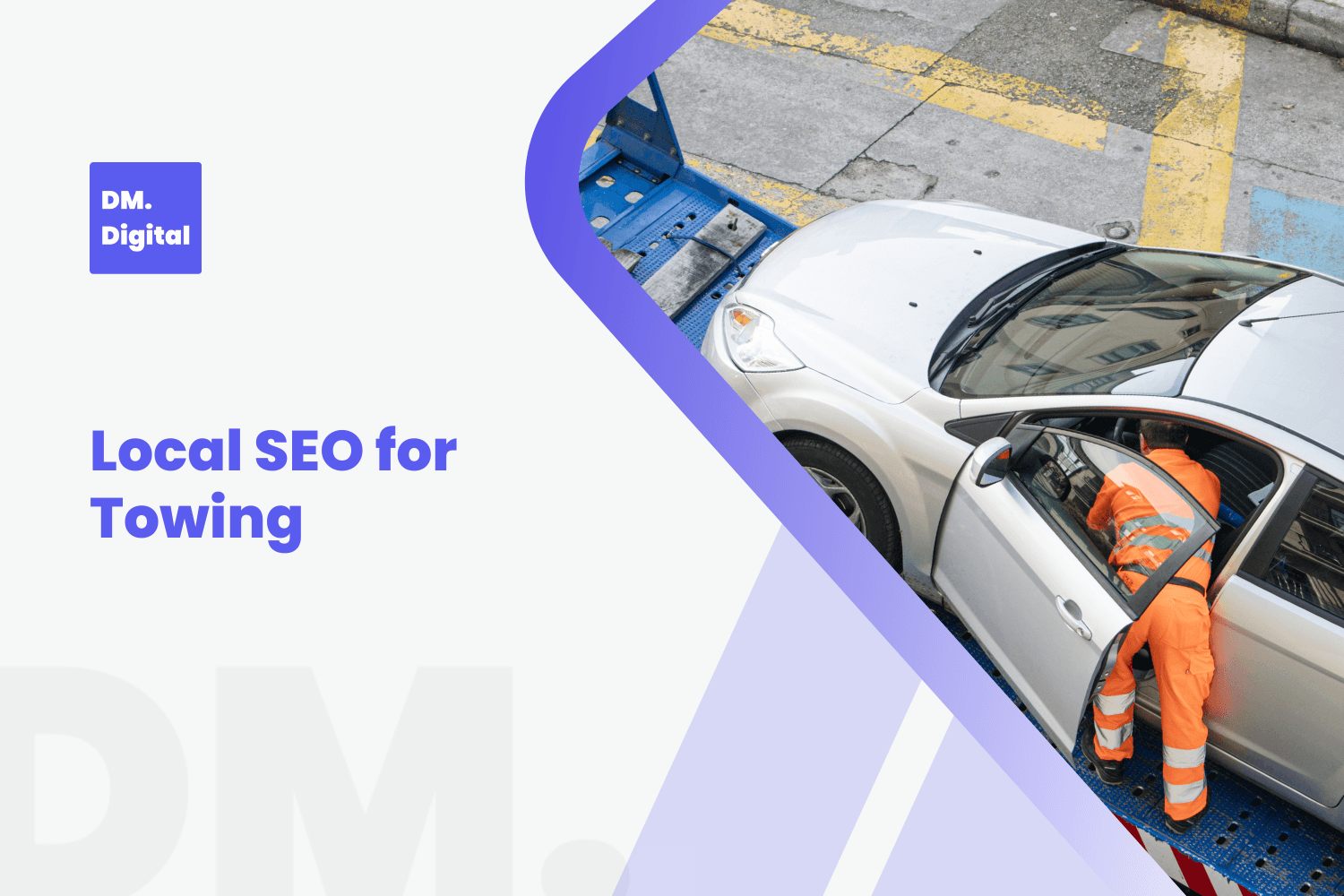
OUR SERVICE AREA
DM. Digital serves businesses across the USA and is open 24/7 for SEO in the USA. We handle Google Business Profile, Local SEO, Website Design, Content Strategy, Analytics & Performance and AI Visibility, measured by the calls and forms they bring in.
Let's get you more clients
Get your free SEO audit. We'll help you get more leads, visibility, and clients for your local business.
Short answer: towing searches are emergencies, and most of them are won or lost in the Google map pack within seconds. Local SEO for a tow company comes down to four things. First, set a service area your trucks can honestly reach quickly, and enter it in your Google Business Profile the way Google's rules require: cities or postal codes, up to 20 areas, no more than about 2 hours of driving. Second, build one real page for each type of tow job and for each town you genuinely cover, never copy-paste city pages. Third, prove you are a real, licensed operator, because cloned and fake tow listings are a documented problem: matching name, phone and address everywhere, visible license and USDOT numbers, published rates and steady reviews. Fourth, make the phone the center of everything and measure the calls you get and miss. None of this guarantees rankings, but it is what the map pack, the organic results and AI tools all reward.
This guide covers how towing search behavior differs from other trades, how to define and enter a dispatch radius, how to build location and service pages that do not read as doorway pages, how to set up a Google Business Profile for calls, the trust problem fake listings create, reviews, state rules that shape what you publish, Local Services Ads, AI search, measuring calls, seasonality and the mistakes that hold tow companies back.
Because the customer is stranded, stressed and often unsafe, so the decision takes seconds and happens almost entirely on a phone.
A homeowner comparing plumbers might read three websites and call back tomorrow. A driver stuck on a highway shoulder does not. They search, look at the map results, check star ratings and tap the first call button that looks trustworthy. Whoever answers gets the job.
Search data reflects this. In an Ahrefs check of six towing searches in October 2026, a Google map pack appeared on five of them and an AI Overview on only one, and neither of the two "near me" searches showed an AI Overview. That is one dated observation, and results vary by location and over time, but it points the same way as everything else about this trade: hiring searches in towing run mainly through the map pack, which rests on the Google Business Profile.
Demand is large and steady. Ahrefs estimated that US monthly searches for "towing near me" averaged roughly 98,000 to 120,000 a year from 2022 to 2024, with "tow truck near me" at roughly 120,000 to 130,000 and "towing service" at roughly 51,000 to 58,000, and that none of these had a consistent peak month. These are third-party estimates, useful for direction rather than exact counts.
Stranded drivers type short, urgent searches: "tow truck near me," "24 hour towing," "roadside assistance." They rarely include a city name. Google's data on mobile search has shown this for years. A 2018 Think with Google article reported that smartphone users were dropping location words like ZIP codes and neighborhoods from local searches because they assume results will match their location. That data is from 2015 to 2017, but the behavior it describes is exactly how towing customers search.
Google already knows where the searcher is. Google says local results are based mainly on relevance, distance and prominence, and that distance is how far each business is from the person searching. So a tow company does not need to repeat "near me" on its pages. It needs a profile and site that are clearly relevant to towing, a real presence in the area, and enough prominence, mostly reviews and reputation, to stand out.
A contact form is nearly useless to someone standing next to a disabled car. In towing, the phone call is the conversion. Every page, every headline and every button should make calling a live dispatcher the easiest thing to do, and success should be measured in answered calls, not traffic or rankings alone.
Most of those calls come from phones. BrightLocal's 2026 consumer search data says 73% of local searches start on a mobile device, and for towing the share is likely higher. Since July 5, 2024, Google has also crawled sites only with its smartphone crawler, as Search Engine Land reported. A towing site that works poorly on a phone fails both the customer and Google.
Breakdowns happen at 2 a.m., and many tow companies run around the clock. Google's Business Profile lets owners set a 24-hour option for each open day. Google's guidelines say to list your regular customer-facing hours, so 24/7 should be listed only if someone actually answers and dispatches at all hours. Sterling Sky's guidance, a practitioner view rather than a Google rule, is that a service-area business can list 24/7 if it can answer the phone and provide service at all times.
Accurate hours matter for searches that include "open now," and Google asks owners to confirm holiday hours even when they match regular hours. But no one should promise that 24/7 hours alone raise rankings. Listing 24/7 and then missing calls at night produces exactly the kind of reviews that hurt a towing business most.
A large, fragmented market where small local operators compete with each other and with motor club networks.
IBISWorld estimated 40,287 US automobile towing businesses in 2025, with $14.5 billion in revenue and about 102,000 employees, and revenue growth of 5.4% a year since 2020. That is a lot of operators competing for the same local searches, which is why the map pack matters so much.
Much towing work also flows through referral networks rather than search. Agero, one roadside network, says it dispatches 14 million jobs a year for more than 120 insurer, automaker and transport programs, and AAA said it answered more than 30 million roadside calls in 2025, according to AAA Mountain West Group. Motor club work brings volume at contracted rates. Direct calls from search let a company set its own rates, which is why many operators invest in local SEO to balance club work with direct customers.
Pricing gives a sense of job value. The Zebra reported in August 2025 an average tow of about $109, with per-mile rates of $2.50 to $7 (about $4.75 on average) plus a hook-up fee, and noted many insurers reimburse only up to $50. That is one consumer guide's figures, and rates vary widely by area, vehicle and job type.
Every town you claim is a promise that a truck can get there quickly. Claim only what your fleet can keep.
A dispatch radius that stretches too far leads to slow arrivals, and slow arrivals lead to bad reviews. Bad reviews hurt both rankings and the conversion rate from the map pack. The right service area is built on drive time, truck locations and staffing, not a hopeful circle on a map.
Ten miles on an open rural road and ten miles through downtown at rush hour are very different promises. Customers feel response time, not distance. The practical approach is to map the area your trucks can reach within the arrival window you are willing to quote, using drive-time estimates at different times of day and real test runs during morning and evening traffic. Those tests usually shrink the area an owner thought they could cover.
There is no industry-standard arrival target that suits every operator. A rural company covering long highway stretches will quote differently from an urban operator with trucks staged across the city. What matters is that the window you publish and quote is one you meet consistently.
Real service areas follow roads. The reachable area stretches along interstates where trucks move quickly and pulls in around bridges, interchanges and corridors that back up at predictable times. A company that knows its slow spots can quote honest arrival times during peak hours instead of overpromising. That same knowledge, which exits you cover, which corridors you run most and where breakdowns cluster, becomes useful detail for location pages later.
Coverage has to match capacity. A one-truck operator tied up on a single job cannot honestly claim a wide area, because the next caller waits until that job ends. The radius should be small enough that a second or third call during busy hours still gets a reasonable arrival time.
Staffing by shift matters too. A company with several daytime drivers but one overnight driver should either tighten its overnight coverage or quote longer night-time arrival times. As the fleet grows, coverage can grow with it. Staging a truck on the far side of town can make a new set of towns reachable within your window. Coverage should follow capacity, never run ahead of it.
Most tow companies are service-area businesses, and Google has specific rules for how they set up their profiles.
Google's service area help page says you can set up to 20 service areas, defined as cities or postal codes rather than a radius, and that the overall area should not extend more than about 2 hours of driving from where the business is based. Google's profile guidelines say service-area businesses should hide their address from customers.
A tow company that always goes to the customer is a service-area business and should hide its address. A company with an impound or storage lot that the public visits during set hours, to release vehicles or collect belongings, may qualify as a hybrid business, which can show its address and also set service areas. The test is whether customers actually come to that location. If they do, the hours listed should be the hours the lot is open to the public.
Google's guidelines say a business that rents a mailing address where it does not operate is not eligible for a profile there, P.O. boxes and remote mailboxes are not acceptable, and a virtual office is allowed only if it is staffed during business hours. Lead generation agents are also ineligible. This matters in towing more than most trades, because fake listings with fake addresses are common, and Google suspends profiles that break these rules.
Not on their own. The Whitespark 2026 Local Search Ranking Factors survey of 47 experts ranked "Setting Service Areas in GBP" 152nd of 187 factors for the map pack, while proximity of the business address to the searcher ranked 2nd. In other words, the service area list mostly tells customers where you work. It does not let a company rank in towns far from its base. The experts also flagged service areas larger than 2 hours of driving as a negative factor with suspension risk. Enter the towns your trucks really cover, and rely on location pages, reviews and real local presence for visibility in those towns.
Ready to Grow Your Local Business?
DM. Digital helps local service businesses dominate Google with custom-built websites.
Build a real page for each town you genuinely serve, and nothing for towns you cannot reach.
Google's spam policies define doorway abuse as pages created to rank for specific, similar searches that lead users to intermediate pages less useful than the final destination. Google's examples include having multiple pages targeted at specific regions or cities that funnel users to one page, and creating substantially similar pages that are closer to search results than a clearly defined hierarchy. Scaled content abuse, many pages generated mainly to manipulate rankings, applies however the pages are made, including with AI tools.
The classic towing mistake is fifty pages that read "Fast towing in [City]. Call now," with only the town name changed. As a Search Engine Land analysis describes, that pattern is the textbook doorway risk, and the risk grows with scale. Pages with real place-specific information are much less likely to read that way.
If you cannot write something genuinely different and useful about a town, that town probably does not need its own page yet. Five detailed pages for towns you cover well beat fifty thin ones. Expert opinion supports this direction: the Whitespark survey ranked geographic keyword relevance of content 2nd of all factors for local organic results, but that relevance has to come from real content, not a list of town names. Google's spam policies specifically list blocks of text listing cities a page is trying to rank for as keyword stuffing.
One page per job type lets each specific search find the right answer.
The Whitespark survey ranked "Dedicated Page for Each Service" 1st of all factors for local organic results. Someone searching "motorcycle towing" and someone searching "heavy duty wrecker" want different things, use different words and often have different budgets. A single services page listing everything gives Google and AI tools much less to match.
Jump-starts, lockouts, fuel delivery and tire changes are quick fixes with their own searches. A roadside assistance page should cover each service, typical arrival times and how pricing works. A flatbed towing page covers the bigger job: when a flatbed is needed, how the vehicle is secured, and what happens from the call to the drop-off. Drivers with all-wheel-drive, lowered or newer vehicles often search for flatbed service specifically.
Heavy-duty towing and recovery for semis, buses and RVs is a different business with different equipment and different customers, often fleet managers and dispatchers. A heavy-duty page should show the actual trucks, their capacities and the recovery equipment. Note that federal rules apply to larger vehicles: the FMCSA requires a USDOT number for vehicles of 10,001 pounds or more in interstate commerce, and 38 states plus Puerto Rico also require one for intrastate carriers. Showing your USDOT number on heavy-duty pages is both a requirement in many cases and a trust signal.
Motorcycle towing is another distinct search. Riders worry about damage, so explaining the equipment and how bikes are secured builds trust. Exotic and luxury vehicle transport, equipment hauling and long-distance towing can each earn a page where real demand exists.
After a crash, drivers are shaken and dealing with police and insurers. A page for accident recovery should explain calmly what happens at the scene, where the vehicle goes, how to retrieve belongings and how insurance billing works. It should never imply a relationship with police or insurers that does not exist. Pages that explain the process clearly answer the questions drivers have at their most stressful moment.
Companies that do private property or nonconsent towing need a page for people whose vehicle was towed. It should explain where the vehicle is, the hours it can be released, what documents to bring, accepted payment methods and the fees allowed under local rules. This page often draws angry visitors, so clarity here prevents complaints and bad reviews.
Towing has a reputation for surprise fees, and regulators have noticed. In February 2024 USDOT and FMCSA called out hidden and junk fees in heavy truck towing, as CCJ reported, and in July 2026 North Carolina's Attorney General issued a warning to predatory towing companies. Publishing how pricing works, such as hook-up fees, per-mile rates and after-hours charges, or at least clear ranges, reassures callers and sets you apart. Licenses, permits, insurance and USDOT numbers belong on service pages too.
Towing is regulated at the state and local level, and those rules affect what your website should say. This is a factual overview, not legal advice, and rules change, so check your own state and city.
For SEO purposes, the takeaway is simple. Show license and permit numbers where your state requires or expects them, publish rates where rules require posted rate sheets, and never imply ties to police, highway patrol or insurers you do not have. Accurate, compliant pages are more trustworthy to customers and give AI tools correct facts to repeat.
For most tow companies, the profile is the biggest single source of calls, so every field should push toward one tap on the call button.
The primary category carries the most weight. For most tow companies it should be "Towing service." Secondary categories such as "Roadside assistance service," "Auto wrecker" and "Vehicle recovery service" are commonly recommended, according to a third-party towing SEO guide, though the exact list available should be checked in the profile itself. Choose only categories that match services you actually perform. The services list should name each job type, flatbed towing, lockout service, jump-start, heavy-duty recovery, so the profile matches specific searches.
Use your real business name exactly as it appears on your signage and registration. Google's guidelines say adding unnecessary information, such as "24/7 Towing Near Me" or city names, can lead to suspension. Keyword-stuffed names are common among fake towing listings, which is one reason Google watches this vertical closely.
Photos of your actual trucks, drivers and completed jobs show a searcher that this is a working business. Google's photo guidelines call for in-focus, well-lit JPG or PNG images between 10 KB and 5 MB and say photos should represent reality. Trucks with visible company branding are especially useful, because they help distinguish a real operator from a cloned listing. Drivers can take a quick photo after a safe job, and those images can be added to the profile regularly.
Profile posts can share seasonal tips, coverage updates and offers. Be realistic about what they do. A Sterling Sky test found weekly posts had no measurable impact on map pack rankings, and experts rank post frequency low. Posts are worth doing because customers who view the profile see them, not because they move rankings.
The phone number on the profile must ring a line that is answered quickly by someone who can dispatch. Google's performance report counts calls as taps on the call button, so it shows how many people tried to call from the profile. There is no point ranking first if those calls go to voicemail.
Towing is one of the verticals scammers target most, which makes proof of legitimacy part of your SEO.
In March 2025, Google sued a scam network after removing more than 10,000 fake Maps listings targeting what it called duress verticals, including towing and locksmiths, as CBS News reported. In January 2024, KWQC reported that scammers had copied Quad Cities tow companies' Google listings with their own phone numbers, taken payment and never sent a truck, with one customer reportedly paying over $2,000.
The problem is not new. A 2017 UC San Diego and Google study of more than 100,000 fraudulent Maps listings found on-call contractors such as plumbers and locksmiths made up 40% of fake listings. Towing was not reported separately, and Google's systems have changed since. In 2025, Google said it removed over 13 million fake Business Profiles and blocked or removed over 292 million policy-violating reviews, according to Search Engine Roundtable.
For a legitimate operator, this creates both a risk and an opportunity. The steps that help customers tell a real company from a clone:
If you find a fake listing, Google lets you report it from Maps, and suspicious names or phone numbers can be reported through Google's redressal form. No one can promise removal, but documented reports help.
Ready to Grow Your Local Business?
DM. Digital helps local service businesses dominate Google with custom-built websites.
Reviews help prominence in the map pack and tell a nervous driver whether a company is safe to call.
The BrightLocal Local Consumer Review Survey 2026 found that 97% of consumers read reviews, 74% look for reviews written in the last three months, and 45% have used AI tools for local recommendations. For towing, where people fear being overcharged or stranded, recent reviews describing fast, honest service are among the strongest assets a company can have.
The best time to ask is right after a successful job, when the customer is relieved. A short text with a direct review link, sent the same day, is the simplest system. Make it routine for every completed job, not just the ones that went perfectly. Google's review policies ban asking only happy customers, discouraging negative reviews and offering discounts or payments for reviews. In the US, the FTC rule banning fake reviews, effective October 21, 2024, prohibits fake reviews including AI-written ones, incentives tied to a particular sentiment and review suppression.
Customers naturally describe where they were and what happened: "towed me off the highway near the mall in twenty minutes." That detail is useful to future readers. The Whitespark survey ranked keywords in reviews 36th for the map pack, a modest factor, so the main value of these descriptions is trust, not ranking. Invite customers to describe their experience, but never script their words.
Private property tows and fee disputes generate angry reviews, sometimes with words like "predatory." The reply matters because every future customer reads it. Google's reply tips say to keep responses short and timely, never share private information and apologize when appropriate. A calm reply that explains the policy, cites the authorization or rate rules where relevant and offers to talk offline shows readers a professional operator. A heated reply makes the business look like the problem.
Reviews that break Google's policies, such as reviews from competitors, people who were never customers or harassment, can be flagged. Google's removal process says evaluation typically takes several days, and each flagged review gets one appeal. A negative review that follows the policy stays up, so a good reply is the real defense.
Towing is a Local Services Ads category, and the ads sit above the map pack, so it helps to understand how they relate to SEO.
Local Services Ads are pay-per-lead ads at the top of Google results. Google lists towing among its Local Services categories. To qualify, Google's screening requirements for "auto towing and roadside assistance" include business and owner background checks, insurance such as general liability, garage keepers, cargo and on-hook coverage, and business and owner licenses where local law requires them. Advertisers also need a public, verified Google Business Profile.
Two recent changes matter. Google Verified replaced the old Google Guaranteed badge in October 2025, ending the money-back guarantee, as Search Engine Roundtable reported, so any page or ad that still says "Google Guaranteed" is out of date. And Search Engine Journal reported in July 2026 that Google is moving Local Services Ads into Google Ads as pay-per-lead Performance Max campaigns, starting with a limited group of US advertisers in August 2026.
Google's LSA ranking help names responsiveness as a factor and warns that missed calls may hurt it, along with reviews, rating and photos. Those are the same things that drive organic map visibility, so strong reviews and a well-run phone line help both. Local Services Ads are separate from SEO: they are paid, and they stop when the budget stops.
Use AutomotiveBusiness with a service area, not EmergencyService.
Schema markup labels business details for search engines and AI tools. Schema.org has no towing-specific type. AutomotiveBusiness is the closest fit, combined with areaServed to list the towns you cover, plus your name, phone, hours and services. A common mistake is using EmergencyService, which on Schema.org covers only fire stations, hospitals and police stations, not tow companies. Schema should always match what is visible on the page.
AI tools draw heavily on Google Business Profiles and Yelp for local answers, so the basics matter here too.
No study has measured AI citations for towing specifically. The closest proxy is car repair. In a BrightLocal study published in August 2026 of nearly 2 million citations across Google AI Overviews, AI Mode and ChatGPT, car repair answers drew 53.9% of their citations from Google Business Profiles and 19.4% from Yelp. That is an inference for towing, not a measurement, but it suggests the profile and the Yelp listing are the surfaces AI tools are most likely to read.
Where AI answers do appear for towing, they tend to cover research questions: how much a tow costs, what to do after an accident, whether insurance covers towing, flatbed versus wheel-lift. Pages that answer those questions clearly and specifically give AI tools something accurate to cite. Hiring searches, the "tow truck near me" moments, still run mainly through the map pack.
Calls are the outcome that matters, so measure how many come in, how many are missed and where they come from.
The profile's performance report shows call button taps, website clicks, direction requests and the searches people used to find you. It does not count people who read the number and dial it by hand. Tagging the website link on your profile with UTM parameters, as Search Engine Land describes, shows what profile visitors do on your site.
Many tow companies set up call tracking themselves to see which sources drive calls. If you do, protect your listing consistency. Keep your main business number as the primary number on your Google Business Profile and across directories, since Google requires a phone number under the business's direct control. A common practice is to use dynamic number insertion on the website, which shows a tracking number to visitors while the main number stays consistent elsewhere, and to place any tracking number in the profile's additional phone field rather than the primary one.
Every unanswered call in towing likely goes to a competitor within seconds. Your phone system's missed call log is one of the most useful reports a tow company has. A pattern of misses during one shift shows exactly where staffing is short. If you list 24/7 hours, overnight missed calls are both lost revenue and a risk to your reviews.
Where callers are located shows which towns produce demand. A town at the edge of your area that generates steady calls may justify staging a truck closer. A distant area producing slow, low-value jobs may be worth dropping. Reviewing this quarterly keeps your service area, profile and location pages aligned with where the work actually is.
Ready to Grow Your Local Business?
DM. Digital helps local service businesses dominate Google with custom-built websites.
Search volume stays fairly steady year-round, but call types and surges follow the weather.
Extreme weather drives spikes. During a February 2026 cold snap, AAA East Central reported more than 37,000 calls, about 80% above a normal winter week, with 36% for batteries and 34% for tows. Summer has its own pressures: AAA says heat can cut battery life to as little as 2 years, and in June 2025 WJLA reported that the average US vehicle age had hit 12.8 years, with AAA Maryland logging 138,000 summer calls, 44% of them tows.
For SEO, that means timely content and profile updates: winter battery and slide-off pages and posts before the cold arrives, heat and overheating content before summer, and holiday hours confirmed in advance. It also means planning staffing for surges, because a spike in calls you cannot answer turns into missed jobs and frustrated reviews.
Most of the problems that hold tow companies back are fixable once spotted.
Promising fast arrival across too wide an area leads to slow response times, and slow response times lead to one-star reviews that hurt both rankings and conversions. Serve the area you can reach within the window you quote, and grow it as you add trucks and drivers.
Dozens of near-identical town pages are the textbook doorway pattern in Google's spam policies. Fewer, genuinely local pages work better.
Adding "24/7 Towing" or city names to the business name, or listing a virtual office, breaks Google's guidelines and risks suspension. In a vertical Google already polices closely for fake listings, the risk is higher.
A slow site or a phone number buried below the fold costs calls from drivers on weak cell signals. The number should be tappable at the top of every page. Google's PageSpeed Insights shows how real Chrome users experience your pages over the previous 28 days.
Old phone numbers, slightly different names and wrong addresses across directories confuse Google, AI tools and customers. In towing, inconsistency also makes it harder for customers to tell you apart from clones. Audit every listing and keep them identical.
"Google Guaranteed" wording, EmergencyService schema, missing license or USDOT numbers and hidden fees are all signs of an outdated or noncompliant site. Each one is easy to fix and costly to leave.
We start with the profile and trust signals, then build the pages and authority around them.
For a tow company, our work starts with an honest service area and a clean, compliant Google Business Profile: the right categories, accurate 24/7 or shift hours, real truck photos and weekly posts. We set up review requests and responses that follow Google's rules and keep citations identical everywhere, which matters even more in a vertical with cloned listings.
The website is built on our own custom-code platform with tap-to-call on every page, a mobile-first, fast-loading design, a dedicated page for each tow service and genuinely local pages for the towns you cover, written through our content creation and on-page SEO work, with license and USDOT numbers and pricing information where you want it shown. Clients get a monthly report on leads, traffic, domain rating, backlinks and AI mentions, plus a live lead dashboard.
For one garage door company we work with, another trade built on urgent calls, 2 of 9 tracked searches moved onto Google's first page between August and October 2026, and Google AI Overview mentions rose from 1 to 12 between March and September 2026. Results depend on market and competition, and no agency can guarantee rankings or calls.
Engagements start at a budget of $5,000 per month, with no minimum commitment and 30 days notice. You keep your domain, your Google Business Profile and your accounts, and leads go to your own email.
Towing is won in seconds, on a phone, mostly in the map pack. The companies that win are not always the biggest fleets. They are the ones with an honest service area, a clean and compliant Google Business Profile, a real page for each service and each town they truly cover, visible proof that they are a licensed local operator, steady recent reviews and a phone line that gets answered. In a vertical crowded with fake and cloned listings, being clearly real is itself a competitive advantage.
If you want help building the profile, pages and trust signals that turn stranded drivers into calls, contact DM. Digital. Dan will call you back, run an audit and send a proposal.
Last updated on
Why trust DM. Digital?
Founded in 2018, DM. Digital is an SEO Agency serving businesses across the USA. All content is reviewed by our licensed technicians.
Ready to Grow Your Local Business?
DM. Digital helps local service businesses dominate Google with custom-built websites.
Every Google Business Profile field explained with Google's own rules: name, verification, categories, address or service area, description, hours, attributes, services, photos, reviews, posts and performance data.
A week-by-week look at the work a local SEO agency does every month, from audits and profile management to reviews, content, links and reporting, with what Google actually says about each task.
Garage door customers call whoever looks trustworthy and reachable first. Here is how to build the website, protect the Google Business Profile in a high-scrutiny category, earn reviews and show up in AI answers.