Website Design
AI Website Builders vs Traditional Website Builders for Local Businesses
Key Takeaways
- AI website builders launch sites in hours for $10-$30 per month, but produce generic designs and lack local SEO depth.
- Traditional website builders cost more upfront ($1,500-$25,000) and take weeks to launch, but offer full control over local SEO, design, and scalability.
- Local SEO performance heavily favors traditional builds because they allow for service area pages, custom schema markup, and neighborhood-specific content.
- AI-built sites often miss local business schema, NAP consistency details, and location-specific content that drive local pack rankings.
- Service-area businesses covering multiple neighborhoods need individual location pages that AI builders cannot generate effectively.
- The best approach for most local businesses combines AI speed for drafting with human expertise for local SEO strategy and customization.
- Both builder types have hidden costs - AI builders charge extra for premium features, while traditional sites require ongoing maintenance and plugin renewals.
- A website should be treated as an ongoing tool, not a one-time project, regardless of how it was built.
In This Article
Imagine a shop owner on Main Street in Henderson, right off Water Street near the new downtown district, trying to figure out how to get a website up and running. Or a plumber in the suburbs of North Las Vegas - maybe out near Aliante or Elkhorn Road - who keeps losing jobs to competitors that show up first on Google. Both of them face the same question: should they use an AI-powered website builder to get online fast, or invest in a traditional website built on WordPress or by a professional developer?
It is not a simple choice. The AI website builder promises speed and low cost. The traditional website builder offers control and depth. For a local business that depends on customers within a 20-mile radius, the wrong pick can mean months of lost phone calls and missed appointments.
Let's break down the full comparison - cost, speed to launch, local SEO performance, design quality, ease of maintenance, and real-world results - so local business owners can make an informed decision. We will also cover how blending AI tools with human local SEO expertise often produces the best outcome for businesses serving specific neighborhoods and communities.
What Are AI Website Builders and How Do They Differ from Traditional Builders?
Before diving into which option fits a local business better, it helps to know what each category actually means. An AI website builder and a traditional website builder take very different approaches to getting a site online, and the differences go deeper than most people expect.
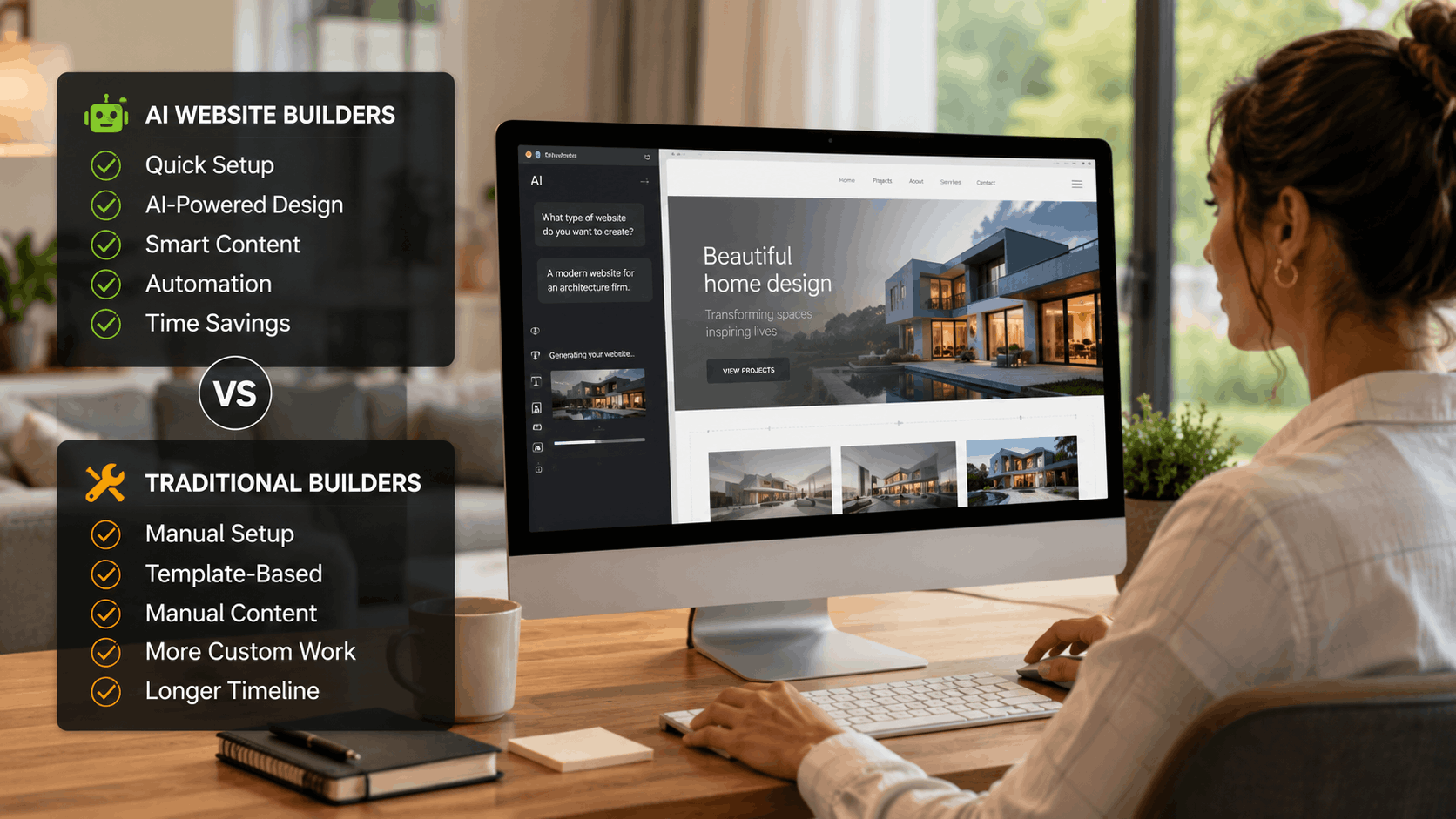
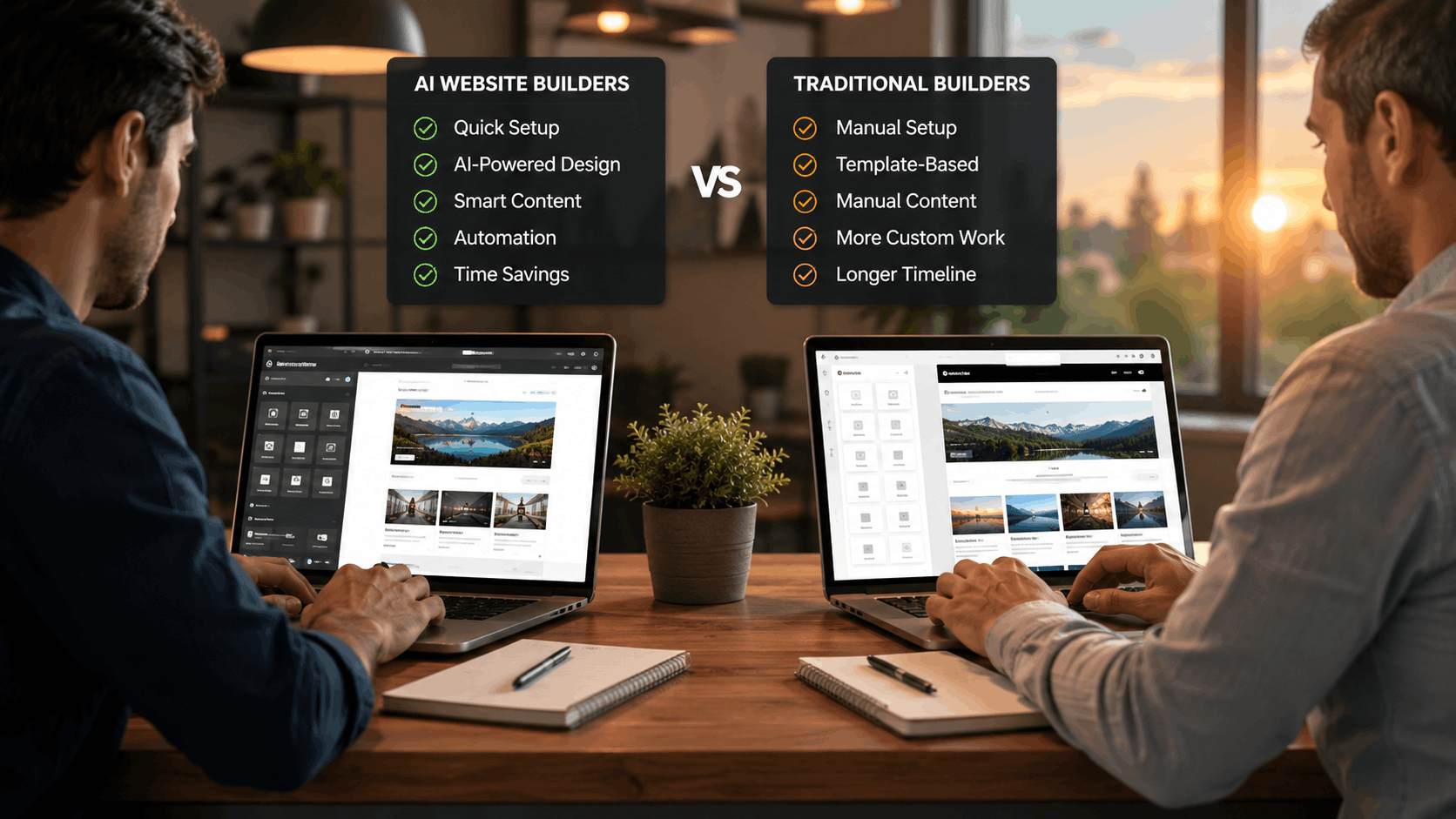
Here is a side-by-side website builder comparison to set the stage:
| Feature | AI Website Builder | Traditional Website Builder |
|---|---|---|
| Setup Process | Answer a few prompts, site is generated automatically | Manual design, layout selection, and content creation |
| Technical Skill Required | None to minimal | Low (drag-and-drop) to high (custom code) |
| Content Creation | AI writes copy based on industry and location inputs | Owner writes or hires a copywriter |
| Design Flexibility | Limited to AI-generated templates | Full control over layout, colors, and structure |
| Local SEO Depth | Basic - auto-generated meta tags | Advanced - custom schema, location pages, blog content |
| Time to Launch | Same day | 1 week to 6 months |
How AI Website Builders Work Behind the Scenes
The process is surprisingly simple. A business owner types in their industry - say "plumbing" - along with their city and the services they offer. Within 30 seconds to 5 minutes, the AI generates a full site with pages, copy, and images already in place. Tools like Wix ADI, Hostinger AI Builder, 10Web, and Durable all work this way.
Behind the scenes, these platforms pull from libraries of templates and content models trained on thousands of existing websites. The AI-generated website looks polished on the surface. It selects stock photos that match the industry, writes service descriptions, and even suggests color schemes.
The catch is that the automated web design follows patterns. It does not know that your HVAC company has been serving the Summerlin area for 15 years or that your bakery sits two blocks from the Springs Preserve. It fills in blanks with generic content that could describe any business in any city.
What Counts as a Traditional Website Builder
Traditional website builders cover a wide range. On the simpler end, platforms like Squarespace and Weebly offer drag-and-drop builders where business owners pick a template and fill in their own content. These require minimal technical skill but still demand time and effort.
In the middle sits WordPress - a full CMS platform that powers over 40% of the web, according to W3Techs. A WordPress website gives business owners control over every detail, but it requires some learning or a developer's help. Then there is custom web development - hiring a freelancer or agency to build a site from scratch with original code and design.
Each level on this spectrum demands more technical knowledge and budget but delivers more flexibility. A drag-and-drop builder works for a basic online presence. A custom website design works for a business that needs to stand out and rank in competitive local markets.
The Gray Area - Builders That Blend Both Approaches
The lines are blurring. WordPress now has AI plugins that generate page content and suggest layouts. Squarespace added AI text generation tools in 2023. Even traditional platforms are borrowing AI website features to speed up the building process.
This creates a hybrid website builder category that did not exist a few years ago. A business owner using WordPress might install an AI plugin to draft blog posts, then manually edit them with local details and neighborhood references.
For the purposes of this article, we are comparing AI-first builders - where the AI does most of the heavy lifting - against manually built sites where a human controls the process from start to finish. The hybrid approach, which we will discuss later, often delivers the best results for local businesses.
Cost Breakdown - What Local Businesses Actually Pay
Money matters, especially for a bakery near the downtown square in Las Vegas or a lawn care company covering zip codes from Summerlin to Green Valley. Local business website pricing varies wildly depending on the path a business owner chooses. Here is what to actually expect.
| Cost Category | AI Website Builder | Traditional (DIY WordPress) | Traditional (Professional Build) |
|---|---|---|---|
| Monthly Platform Fee | $10 - $30/month | $5 - $30/month (hosting) | Included or $50 - $150/month |
| Upfront Design Cost | $0 | $0 (your time) | $1,500 - $25,000 |
| Domain Name | $10 - $20/year | $10 - $20/year | Often included first year |
| Ongoing Maintenance | Included | $0 - $100/month (DIY or managed) | $50 - $200/month |
| Annual Total (Estimate) | $150 - $400 | $200 - $1,500 | $2,000 - $27,000+ |
Monthly and Annual Costs of AI Website Builders
Most AI builders run between $10 and $30 per month for a plan that includes hosting, a basic template, and some AI content generation credits. Some platforms like Durable offer plans starting around $12 per month. Free tiers exist but come with platform branding and limited features - not a great look for a business trying to build trust.
The affordable website builder label fits here, but extras add up. Want a custom domain? That is $10 to $20 per year. Need more AI content credits? Some platforms charge per generation. A local HVAC company does not need the same e-commerce plan as an online retailer, so sticking with a basic business plan keeps AI builder pricing reasonable.
For a brand-new mobile dog groomer or a solo house cleaner just getting started, this price range makes the website cost for small business owners very manageable.
The True Price Tag of a Traditional Website
A DIY WordPress site with shared hosting runs about $200 to $500 per year. The WordPress hosting cost covers the server, and free themes bring the design cost to zero - though the owner trades money for time. Expect 10 to 30 hours of learning and building.
Hiring a freelancer for a professionally designed site costs $1,500 to $10,000 upfront. Web designer pricing depends on the scope - five pages with basic contact forms on the low end, 20+ pages with booking systems and custom features on the high end. An agency-built custom site can run $5,000 to $25,000 or more.
Then come the ongoing costs most business owners forget. Website maintenance cost includes hosting renewals, security monitoring, plugin license renewals ($50 to $200 per year), and occasional troubleshooting. A realistic annual budget for a professionally maintained WordPress site is $600 to $2,000 beyond the initial build.
Hidden Costs That Catch Business Owners Off Guard
Both sides have sneaky expenses. AI builders sometimes charge extra to remove their branding from the site footer - $5 to $10 more per month. Adding contact forms, appointment scheduling widgets, or extra pages may require a higher-tier plan. Those hidden website costs turn a $12 per month plan into $25 quickly.
Traditional sites have their own traps. Premium WordPress plugins for SEO, security, and backups can total $200 to $400 per year in website fees. Managed hosting that handles updates and security runs $30 to $100 per month. And if the site breaks or gets hacked, emergency repairs can cost $200 to $500 per incident.
The most expensive hidden cost on either side? Lost leads. When a site goes down during a busy season - say peak summer for an AC repair company in the Las Vegas valley - every hour of downtime means missed calls and lost revenue that dwarfs any hosting bill.
Ready to Grow Your Local Business?
DM. Digital helps local service businesses dominate Google with custom-built websites.
Speed to Launch - Getting Online Before the Competition
For a new dentist office opening near Palo Verde High School in Summerlin or a restaurant taking over a space on East Fremont, timing matters. Every week without a website is a week where potential customers search, find nothing, and call a competitor instead. The time to build a website varies dramatically between AI and traditional options.
AI Builders Can Produce a Site in Under an Hour
The speed claims are real - with a caveat. Here is the realistic timeline for getting a site live with an AI builder:
- AI generates an initial draft site in 30 seconds to 5 minutes after the owner inputs business details
- Reviewing and editing auto-generated content takes 1 to 2 hours - swapping stock photos for real ones, correcting service descriptions, and adding accurate business information
- Connecting a custom domain and configuring basic settings adds another 30 to 60 minutes
- Total realistic launch time: 2 to 4 hours for a functional site
Same-day launch is genuinely possible with a fast website setup. A personal trainer who decides on Monday morning to get online can have a live site by Monday afternoon. That quick website builder advantage is hard to argue against when a business needs an online presence immediately.
The trade-off is depth. A site launched in four hours will not have neighborhood-specific content, a blog, or the kind of on-page SEO structure that drives local search rankings over time.
Traditional Builds Take Weeks or Months - Here Is Why
A traditional website follows a much longer path. Here is the typical website development timeline:
- Discovery and planning: 1 to 2 weeks for gathering business information, reviewing competitors, and defining site goals
- Wireframing and design mockups: 1 to 2 weeks for creating page layouts and getting owner approval
- Content writing: 1 to 3 weeks depending on the number of pages and whether a professional writer is involved
- Development and coding: 2 to 4 weeks for building the site, integrating forms, and configuring SEO elements
- Revisions and testing: 1 to 2 weeks for cross-browser testing, mobile testing, and final changes
A freelancer project usually finishes in 4 to 8 weeks. An agency project can stretch to 3 to 6 months, especially with multiple rounds of revisions. DIY WordPress takes 1 to 3 weeks for someone learning the platform as they go.
How long to build a website the traditional way depends heavily on how responsive the business owner is with feedback and content. Delays in providing photos, approving designs, or writing "About Us" page text are the most common reasons projects drag on.
Local SEO Performance - Which Type of Site Actually Ranks in Local Search
This is where the decision gets serious for local businesses. A beautiful website means nothing if nobody finds it when they search "AC repair near me" or "best dentist in Henderson." The way a site handles local SEO determines whether it brings in customers or just sits there looking pretty. Let's compare how each builder type handles local SEO out of the box.
How AI Builders Handle Title Tags, Schema, and NAP Consistency
AI builders get some things right. Most auto-generate title tags and meta descriptions for each page. They include the business name and sometimes the city. Mobile responsiveness is usually solid. These are baseline requirements that modern AI platforms handle adequately.
Where they fall short is the deeper work. Few AI builders automatically add local business schema markup - the structured data that tells Google exactly what type of business the site represents, where it is located, and what services it offers. Without proper SEO audit and manual intervention, this data is often missing or incomplete.
NAP consistency - making sure the business Name, Address, and Phone number match across the website, Google Business Profile, and every directory listing - depends entirely on what the owner inputs. The AI does not cross-reference with existing listings. We regularly find AI-built sites with slight address variations or missing suite numbers that create conflicting signals for Google. That is the kind of on-page SEO detail that costs local rankings.
Why Traditional Sites Still Have a Local Ranking Advantage
Traditional builds allow for the kind of depth that moves the needle in local search results. A WordPress site can have a dedicated page for each service area - one for Summerlin, one for Henderson, one for the Arts District, one for Spring Valley. Each service area page targets location-based SEO terms that residents actually search for.
These local landing pages can include embedded Google Maps, neighborhood-specific content about the types of homes or businesses in that area, and references to nearby landmarks that build geographic relevance. A pest control company can write about the specific pest issues in older homes near the UNLV campus versus newer construction in Inspirada.
Custom schema markup, internal linking between location pages and service pages, and blog content targeting local long-tail searches - these are the signals that Google uses to decide who ranks in the local results. An AI builder typically cannot replicate this depth without so much manual work that the speed advantage disappears. This is exactly why SEO-focused content creation remains a human-driven process.
Google Business Profile Integration and Local Pack Rankings
The local pack - those three business listings that appear with a map at the top of Google results - is where most local leads come from. According to BrightLocal's research, a majority of consumers use Google to find local businesses, and the local pack is often their first stop.
Both AI and traditional sites can link to a Google Business Profile. But the connection goes deeper than just a link. Google looks at the linked website for relevance signals - does the site content match the GBP categories? Does the NAP data line up? Are there pages that support each service the business claims to offer?
Traditional sites give business owners far more control over these signals. Internal linking to location pages, review widgets, locally relevant blog posts, and city-specific landing pages all strengthen the relationship between the website and GBP. We approach Google Business Profile management and website development as connected systems - because Google treats them that way. A strong website with local content directly supports higher local pack rankings.
Design Quality and Customer Trust - First Impressions for Local Customers
When a homeowner in Green Valley Ranch is comparing three roofers side by side, the website creates an instant gut reaction. Does this business look legitimate? Do they seem professional? Would I trust them inside my home? These snap judgments happen in seconds, and the design of the site drives most of them.
AI-Generated Designs - Clean but Generic
AI builders produce modern, mobile-friendly layouts that look polished at first glance. The colors coordinate, the spacing is clean, and the fonts are readable. For a brand-new business with no existing branding, this is a decent starting point. The AI website templates are designed to look acceptable across all industries.
The downside is sameness. A local electrician's AI-built site in Las Vegas may look nearly identical to one in Phoenix or Chicago. The same stock photos of smiling technicians. The same generic taglines about "quality service." In a local market where word-of-mouth and community reputation matter, this generic website design hurts memorability.
When a customer visits three sites that all look the same, none of them stand out. The business that invested in original photography, real project images, and a design that reflects their actual brand wins the trust comparison every time.
Custom-Built Sites That Reflect the Local Brand
A traditional build allows for original photography - actual photos of the team, the shop, the trucks, the finished projects. It allows for branded color schemes that match business cards and vehicle wraps. Neighborhood references, customer testimonials with real names and locations, and a voice that matches how the owner actually talks to customers over the phone.
A family-owned plumbing company that has served Clark County for 30 years deserves a site that tells that story - not a cookie-cutter page that could belong to any plumber anywhere. Custom website design and strong local business branding build the kind of brand identity website that turns browsers into callers.
This is where professional website design pays for itself. The investment in a site that genuinely represents the business builds website credibility and small business website trust in ways a template cannot match.
Ready to Grow Your Local Business?
DM. Digital helps local service businesses dominate Google with custom-built websites.
Ease of Maintenance and Updates for Non-Technical Owners
Most local business owners are running crews, seeing patients, managing employees, or standing behind a counter all day. They do not have time to learn code. They need to update holiday hours, post an announcement about a new service, or swap out a seasonal photo - and they need to do it without calling a developer every time.
AI Builders Make Simple Edits Painless
This is a genuine strength of AI platforms. Most no-code website editors let business owners click on any text block and start typing. Swapping an image means clicking the photo and uploading a new one from a phone. Some platforms even accept natural language requests like "add a section about our new deck staining service" and the AI generates a draft.
For easy website changes like updating a phone number, changing business hours, or adding a quick announcement, AI builders are hard to beat. A busy restaurant owner can update the lunch special from the back kitchen on a tablet. A mobile mechanic can add a new service offering while sitting in the truck between jobs. That simplicity has real value for non-technical owners.
Traditional Sites Need More Hands-On Care
WordPress and custom-coded sites require regular WordPress maintenance - updating plugins, themes, PHP versions, and security patches. Skip these for a few months and the site becomes vulnerable to hacking or starts displaying broken elements. Website security updates are not optional; they are ongoing requirements.
Many business owners end up paying $50 to $150 per month for managed website hosting or a maintenance plan that handles these updates automatically. Squarespace and Wix handle most of this in the background, but WordPress does not - it puts the responsibility on the site owner or their developer.
The irony is that the platform offering the most flexibility also demands the most attention. For business owners willing to pay for a maintenance plan, this is a non-issue. For those trying to handle everything themselves, it can become a frustrating time sink.
What Happens When Something Breaks
With an AI builder, support is usually a chatbot or email ticket. Response times range from immediate (for chatbots with canned answers) to 24 to 72 hours for actual human help. There is no local contact, no one who knows the business, and no one who can jump on an emergency at 9 PM on a Friday.
With a traditional site built by a local agency or freelancer, the owner often has a direct phone number or email for someone who understands the site inside and out. That web developer support relationship matters when the site crashes during peak season - say July for a pool service company or December for a restaurant handling holiday catering orders.
Website downtime costs money. A week without a functioning site for a business that depends on web-generated leads can mean thousands in lost revenue. The value of responsive website support is easy to overlook until it is desperately needed.

Which Option Works Best for Different Types of Local Businesses
There is no one-size-fits-all answer here. A solo house cleaner has very different website needs than a multi-location auto repair shop. The best website builder for small business owners depends on where they are in their growth journey and how they get customers.
Solo Operators and Brand-New Businesses
For a new personal trainer working out of a gym near Town Square, a mobile notary just getting started, or a freelance photographer building a portfolio - an AI builder is often the smart first move. It provides a startup website and a new business online presence at minimal cost. Getting a solo business website live in one afternoon beats waiting six weeks for a developer.
The goal at this stage is to exist online. Have a site that shows up when someone Googles the business name, displays accurate contact information, and looks professional enough on a phone screen. Revenue can fund a better site later once the client base grows.
Established Businesses Ready to Grow
A plumbing company doing $500K per year, a dental practice adding a second location in Henderson, or a law firm expanding into new practice areas - these businesses need more from their website. Multiple service pages, appointment booking integration, review displays, and keyword research and intent mapping for each service line are table stakes at this level.
A growing business website needs to be scalable. Adding new location pages, blog content, and landing pages should not require starting over. A multi-location website built on WordPress or a similar CMS handles this kind of expansion naturally. AI builders hit their limits quickly when the site needs to grow beyond a handful of pages.
Service-Area Businesses That Cover Multiple Neighborhoods
This is where the difference between AI and traditional builders becomes most stark. A pest control company covering a 30-mile radius from central Las Vegas - serving Summerlin, Spring Valley, Paradise, Enterprise, and out to Boulder City - needs individual pages for each area to rank in local search results for each community.
AI builders are weak at producing this kind of service area business website. They generate one generic page, not ten location-specific pages with unique content about each neighborhood's typical pest issues, housing styles, and seasonal concerns. Multi-location SEO demands dedicated landing pages with local service content for each target area.
This is the scenario where a traditional build paired with a local SEO strategy delivers the most return on investment. Each local service page becomes a magnet for searches from that specific neighborhood - and those are the searches that turn into booked jobs.
How Combining AI and Local SEO Expertise Produces Better Results
The smartest approach for most local businesses is not picking one side. It is using AI tools where they save time and applying human local SEO expertise where it makes the biggest difference. This is not about technology versus tradition - it is about using the right tool for each part of the job.
Using AI to Speed Up the Build Without Cutting Corners
AI excels at generating first drafts. Initial content outlines, suggested page structures, and repetitive tasks like resizing images or formatting text - these are areas where AI-assisted web design saves hours without sacrificing quality.
The process looks like this: AI generates an initial content draft for a service page, then a human editor rewrites it with local details - references to specific neighborhoods served, mentions of common local issues, and language that sounds like it was written by someone who actually works in the area. The result is a faster website launch that does not sacrifice the local depth that drives rankings.
A content strategy that combines AI speed with human local knowledge consistently outperforms either approach used alone.
Local SEO Strategy That AI Cannot Replicate on Its Own
AI does not know that the neighborhoods west of the I-215 in Summerlin have different home ages and construction styles than the master-planned communities in Inspirada. It does not know which Google Business Profile categories perform best for a specific type of contractor in a specific market. It cannot analyze what local competitors are doing and identify gaps.
Local market knowledge - knowing where to build citations, how to structure GBP categories, which neighborhoods to target first, and what kind of content resonates with residents in a particular area - is a human skill. AI can assist with research and drafting, but the Google Business Profile optimization decisions that move local rankings require someone who understands the market.
According to Google's own documentation on how local results work, prominence, relevance, and distance all play into local rankings. A human strategist applies these factors to a specific business in a specific city. AI simply cannot do that with the nuance required.
Ready to Grow Your Local Business?
DM. Digital helps local service businesses dominate Google with custom-built websites.
Final Thoughts
AI website builders and traditional website builders each have a place in the local business world. For solo operators and brand-new businesses, AI builders offer a fast, affordable entry point. For established businesses, multi-location operations, and service-area companies that depend on local search traffic, a traditional or hybrid build delivers the depth and SEO performance that generates real leads.
The best approach for most local businesses combines the speed of AI with the precision of human local SEO work. If your current site is not bringing in calls and appointments from customers in your service area, it might be time for a different approach. Reach out to us for a conversation about what your website should be doing for your business - and what it is costing you by falling short.
Frequently Asked Questions
Can an AI website builder rank my business on Google?
An AI website builder can produce a site that appears in search results, but ranking well in local searches requires specific work that most AI builders skip. Local business schema, service area pages targeting individual neighborhoods, and content written around location-specific searches are the factors that drive local search ranking. Without these, an AI-built site may show up for branded searches but miss the "near me" and city-specific queries that bring in new customers.
How much does a good local business website cost?
A local business website cost ranges from $10 to $30 per month for AI builders, $200 to $500 per year for DIY WordPress, and $1,500 to $10,000 for a professionally built site. The cheapest option is not always the best investment. A $15 per month AI site that generates zero leads costs more in lost opportunity than a $5,000 site that brings in multiple new customers each month. Website pricing should be weighed against expected return.
Will my customers notice if I used an AI website builder?
Most customers will not notice or care whether a site was built with AI, as long as it loads fast, looks professional on mobile, and displays accurate contact information. What they will notice is missing business hours, broken links, stock photos that look nothing like the actual business, or content that reads like it was written for a company in another state. AI website quality is acceptable for first impressions - but accuracy and authenticity build real trust.
Do I own my website if I build it with an AI platform?
Most AI builders host the site on their own servers, meaning the business owner cannot easily export the site and move it elsewhere. The content itself - text, images the owner uploaded - belongs to the owner, but the design and code stay with the platform. WordPress sites are portable and can be moved to any host. Platform lock-in is a real risk for local businesses that may want to switch providers down the road. Always read the terms of service before committing.
Can I switch from an AI builder to a traditional website later?
Yes, but it means rebuilding. Most AI builders do not export clean, usable code. The written content can be copied to a new site, but the design and page structure will need to be recreated from scratch. If a business expects to grow beyond a basic five-page site within a year or two, planning for an eventual migration is wise. Starting with AI is fine - just budget for the switch when revenue supports it.
Which website builder is best for a service-area business?
A traditional CMS like WordPress is the better choice for a service area business that covers multiple cities or neighborhoods. It allows for individual location pages, each targeting specific local search terms - like "plumber in Henderson" or "HVAC repair Spring Valley." AI builders generate one generic homepage and cannot create the multi-city website structure that ranks across multiple service areas. We build these types of sites with local SEO baked in from day one.
How does my website affect my Google Business Profile ranking?
Google looks at the website linked from a GBP listing for relevance signals. NAP consistency between the site and the profile, content that matches the business categories, and pages covering each service all influence how Google ranks the listing. A strong website with locally relevant content - city names, neighborhood references, service-specific pages - sends clear signals that support higher local pack positions. The website and Google Business Profile work as connected ranking factors.
Should I hire a web designer or use an AI builder to save money?
It depends on the business goals. If the goal is a basic online presence quickly - a page with contact info, hours, and a few service descriptions - an AI builder works well and saves money. If the business depends on local search traffic for leads and competes against established companies with strong websites, investing in a professionally built and SEO-focused site pays for itself through new customers over time. A DIY website versus professional build is a question of expected return, not just upfront cost.
Are AI-built websites mobile-friendly?
Yes, nearly all modern AI builders produce responsive websites that adjust to different screen sizes. Mobile-friendly design is built into their templates by default. However, the auto-generated mobile layout sometimes needs manual adjustments. Text that looks fine on a desktop monitor may stack awkwardly or create uncomfortable reading experiences on a phone. Always preview the site on an actual mobile device - not just the builder's preview tool - before publishing.
What is the biggest mistake local businesses make with their website?
The biggest mistake is treating the website as a one-time project - building it, launching it, and never touching it again. Whether built with AI or by a developer, a site needs fresh content, updated service information, new photos, and regular local SEO work to keep generating leads. A site published two years ago with outdated pricing, old team photos, and no recent blog posts signals to both Google and customers that the business may not be actively operating. Ongoing website improvement is not optional.
D
The DM Digital team builds custom websites and runs Local SEO programs for local service businesses across the USA. Articles from the team reflect on-the-ground experience from real client engagements - Google Business Profile work, neighborhood-page strategy, technical SEO, and conversion optimization for service businesses competing in the map pack.
Licensed in Nevada
Last updated on
Why trust DM. Digital?
Founded in 2015, DM. Digital is an SEO Agency serving businesses across the USA. All content is reviewed by our licensed technicians.
Ready to Grow Your Local Business?
DM. Digital helps local service businesses dominate Google with custom-built websites.
Related Articles
Website Design
How Many Pages Does a Local Business Website Actually Need
Most local businesses need 5-10 focused website pages to rank and convert. Learn which pages matter most, which to skip, and how to plan a site structure that drives real leads.
·32 min read
Website Design
DIY Website vs Done-for-You Website: What Is Better for Local Businesses
DIY or done-for-you? This guide breaks down real costs, local SEO performance, and which website type actually brings in calls for local businesses.
·29 min read
Need a website for your business?
Grow Local creates a complete, SEO-optimized website in seconds. Fill a few fields - AI does the rest. $99/month.