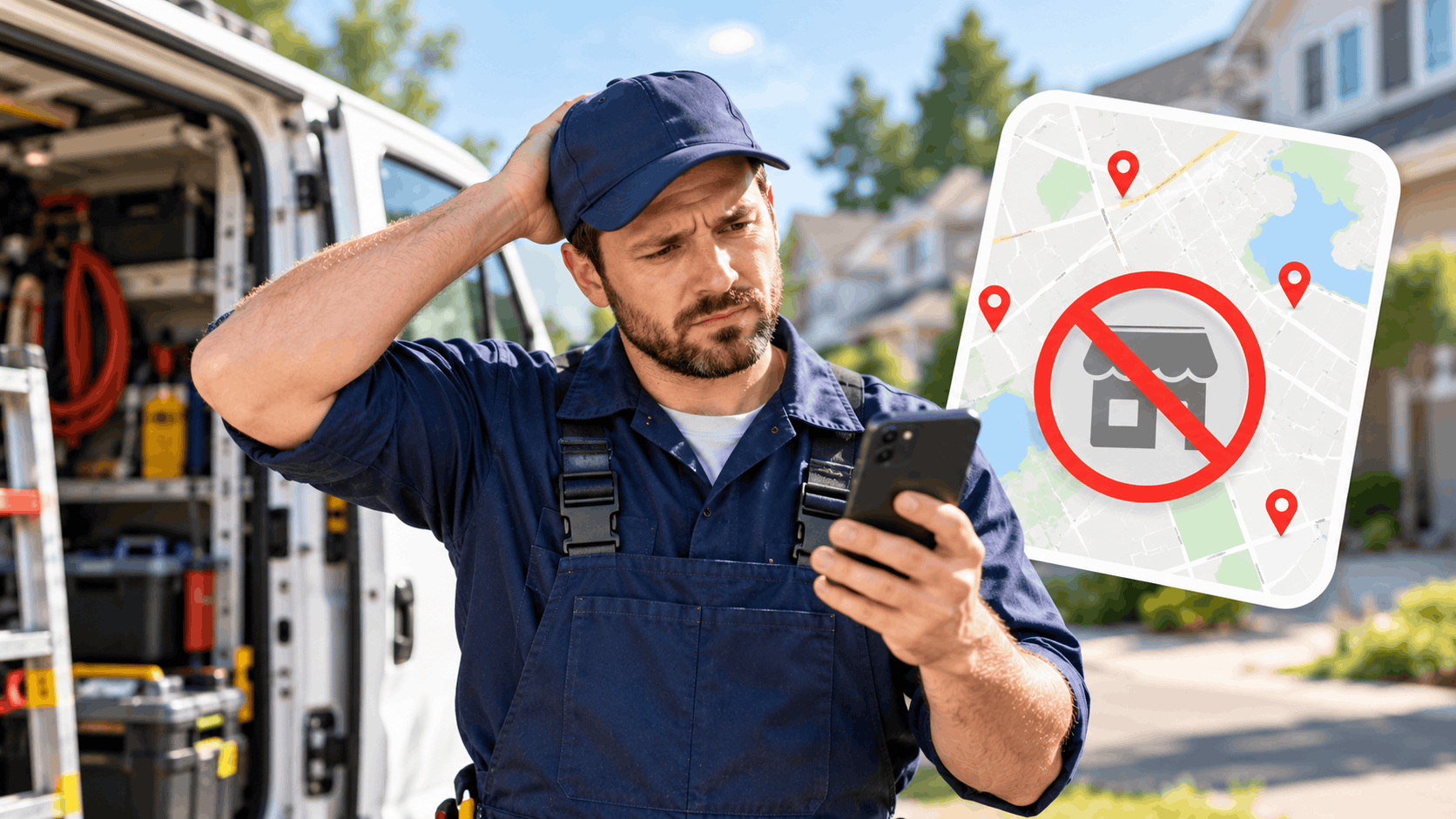
A plumber can rank well in his home town and still vanish a few towns over, even when he knows he can reach those customers in under an hour. He drives there all the time. The work is there. But the profile just does not show up on the map when someone two towns away searches for a plumber.
The short version is distance, service area setup and prominence. Google ranks local results by how well a profile matches the search, how far the business is from the person searching, and how well known the business is. A searcher farther out is physically farther from the base, so closer competitors usually win that search unless prominence is strong enough to offset the gap.
Below, we explain how Google decides which towns show a profile, how to check the settings that are most often set up wrong, and what actually moves a plumbing business into more towns. We also cover verification, suspensions, AI-style local results and the licensing rules that apply when advertising across town and state lines.
How Google Decides Which Towns Show Your Profile?
Google does not show every profile to every searcher. It ranks local results using three things, and those three things are the reason a profile fades out in towns farther from the base. Once an owner sees how the system works, the drop-off in nearby towns stops looking like a glitch and starts looking like math.
| Ranking factor | What it means | Why it affects nearby towns |
|---|
| Relevance | How well the profile matches the search | A wrong category or thin services list weakens matching everywhere |
| Distance | How far the business is from the searcher | Searchers farther out sit closer to competitors |
| Prominence | How well known the business is | Reviews, links and citations help hold visibility across a wider area |
These are Google's own three local ranking factors. Everything else a plumber does to appear in more towns feeds into one of them. Our local SEO work is built around moving all three in the right direction.
Relevance, Distance and Prominence Explained
Relevance is how closely a Google Business Profile matches what someone typed. A profile set up as a plumber with a full services list matches a plumbing search better than a vague or half-finished listing. The more accurate and complete the profile, the more searches it can win.
Distance is measured from the business location to the person searching. That single detail drives most of the frustration owners feel about nearby towns. When a customer two towns over searches, Google measures the gap from that customer back to the plumber's base, and a closer shop usually looks like the better local answer.
Prominence is how well known a business is, including reviews, links and citations. Google states plainly that there is no way to request or pay for a better local ranking. No budget buys a map pack spot, which is why the honest work is building real signals over time rather than hunting for a shortcut.
Put together, these three factors explain the whole pattern. A profile needs to match the search, sit close enough to compete, and carry enough weight that Google trusts it. Weakness in any one of them shows up first in the towns farthest from home.
Why Distance Pushes You Out of Farther Towns
A service area business can serve a wide region, but distance still counts against it on every search. Someone searching two towns over is physically farther from the base, so plumbers who are closer to that searcher usually rank ahead, even when the farther plumber genuinely covers the area. This is normal behavior, not a broken setting.
Think of it from Google's side. When a resident on the far edge of the next town types a plumbing search, Google wants to show help that can arrive quickly. Proximity is a strong signal in that moment, and the map pack leans on it hard for hiring searches.
This is why a plumber can own his home town and still be invisible in a town twenty minutes up the road. Nothing is wrong with the profile. There are simply competitors sitting closer to those searchers, and distance is doing exactly what it was built to do.
Understanding this changes the plan. An owner cannot move his shop closer to every town he serves, so the lever that extends reach is prominence, not distance. The sections below show how to build it.
Prominence Is Why Big Chains Appear Everywhere
Well-known businesses hold up better across a wider area because prominence partly offsets distance. A chain with hundreds of reviews, strong links and clean citations can still surface a few towns out, where a newer independent with a thin profile drops off. The chain is not closer. It is simply more prominent.
Google says more reviews and positive ratings can help a business's local ranking. That line is why steady review activity matters so much for a plumber trying to grow his footprint. Reviews are one of the clearest prominence signals an owner can actually influence.
Links and citations work the same way. When other websites mention and link to a business, and when directories list the same name, address and phone, Google reads the business as more established. That accumulated weight is what lets a listing reach past its immediate neighborhood.
The good news for independents is that prominence is earned, not bought. A focused plumber in one region can build enough reviews, links and citations to compete in the towns that matter most to him, even against larger names.
The Map Pack Shows on Nearly Every Plumbing Search
WebFX tested 100 home services keywords in May 2026, running each several times, and on plumbing searches the Local Pack appeared in 94% of runs, covering 19 of 20 keywords. That makes the map pack the near-constant plumbing result. For hiring searches, it is where most decisions get made.
That same study found Local Services Ads present in 32% of runs and standard Google Ads in just 7%. The map pack dwarfs both. When someone searches for a plumber near me, the three local results are usually the first thing they act on.
Because the map pack shows on almost every plumbing query, being absent from it in nearby towns costs real calls. Every missed appearance is a customer who called a competitor instead. That is the direct cost of a profile that fades out a few towns over.
This is also why the strength of a Google Business Profile matters on nearly every search a plumber cares about. The profile is the engine behind the map pack, and the map pack is the battleground for local hiring. Our map pack optimization work focuses squarely on that.
Check Your Service Area Settings First
Before chasing ranking tactics, an owner should check the simplest fixable cause: a service area that was set up wrong or left incomplete. A plumber cannot show in a town the profile does not even claim to serve. This is the first thing to rule out.
A service area business lists the places it travels to instead of showing a storefront address. If those areas are missing, too narrow or mismatched, the profile loses visibility in exactly the towns the owner cares about most. The settings below are where to look.
Adding Up to 20 Service Areas by City or ZIP
Per Google Business Profile Help as of October 2026, a service area business can add up to 20 service areas by city or ZIP code. If a nearby town is not on that list, the profile is missing a clear signal that the plumber serves it. The fix is to make sure every town that matters is actually listed.
Google also says the service area should not extend farther than about 2 hours of driving from the base. For most plumbers, the towns they can reach in under an hour sit comfortably inside that limit. The guidance is about keeping the area realistic, not about punishing a shop with wide coverage.
Listing by ZIP can be more precise than listing by city name alone, especially where towns blur together at the edges. An owner can mix city and ZIP entries to cover the exact pockets he works in. The goal is coverage that matches reality.
One caution: the 20-area cap means an owner cannot list every town in a large region. Pick the towns that drive the most business and the ones closest to the base, since those are the searches most worth winning.
Listing a Town Does Not Guarantee Top Ranking There
Adding a town to the service area makes the profile eligible to show there. It does not place the profile above closer or more prominent competitors. This is the misunderstanding that trips up most owners who expect a settings change to fix everything.
Eligibility and ranking are two different things. Listing a town tells Google the plumber serves it. Where the profile lands in the results for that town still comes down to distance and prominence, the same two factors at work everywhere else.
So a plumber who adds ten new towns may become eligible in all ten and still rank poorly in the farthest ones. That is expected. The service area list opens the door. Reviews, links, citations and strong service pages decide how far inside the door the profile gets.
The practical takeaway is to treat the service area as a foundation, not a finish line. Get it right first, then put the real effort into the prominence and relevance signals that actually move ranking order.
Hiding a Home Address the Right Way
Many plumbers run from a residential address. Google says service area businesses should hide the business address from customers, using the example of a plumber working from a home clearing it from the profile. The areas served are listed instead of a visible address.
What does not qualify matters just as much. P.O. boxes and remote mailboxes are not allowed, and neither are virtual offices, meaning a rented address where the business does not actually operate. Using one of these invites trouble and can hurt visibility rather than help it.
A messy address setup is a common reason a home-based plumber struggles across the board, not just in far towns. If the address is shown when it should be hidden, or set to a place the business does not run from, the profile can look inconsistent to Google.
The clean setup is simple: hide the home address, list the real towns served, and keep everything accurate. Our profile optimization work handles exactly this kind of configuration for service area businesses.
Why Edits Take Time to Appear
Changes do not show instantly. Per Google Business Profile Help as of October 2026, service area edits can take up to 48 hours to appear, and other changes can take up to 3 days to show on Google Search and Maps. An owner who updates settings and checks an hour later may see nothing different yet.
That delay leads some owners to think an edit failed, so they change it again, which only resets the clock. Patience is part of the process. Make the change once, note the date, and give it time to propagate before judging the result.
Because Google's timing can shift, it is worth confirming the current windows on Google's own help pages when a change seems stuck. The published maximums are stated as typical cases, not promises, so real results can land sooner or later than expected.
Once edits settle, give the ranking itself more time still. Settings propagate in days, but the visibility that comes from relevance and prominence builds over a longer stretch, which the next sections explain.
DM. Digital helps local service businesses dominate Google with custom-built websites.
Why Your Primary Category and Services Matter for Nearby Towns?
Relevance is the third piece of the puzzle, and it travels with the profile into every town it serves. A wrong primary category or a thin services list weakens matching across the whole service area, not just at home. Getting these right lifts the profile everywhere it is eligible.
Category and services tell Google what searches a profile can win. If the plumber label is missing or the services are incomplete, the profile fails to match searches it should easily win, and that failure repeats in every town. Fixing relevance is some of the highest-value work an owner can do.
Set Plumber as the Primary Category
Primary category is one of the top map pack factors in Whitespark's 2026 Local Search Ranking Factors survey. For a plumbing business, that primary category should be Plumber. It is the single most direct signal of what the business is, and it carries weight on every plumbing search.
Secondary categories should only reflect services the business actually offers, such as Drainage service or Water heater installation service. Adding categories for work the plumber does not do muddies relevance and can confuse Google about what the business is. Use as few as truly apply.
Google does not let businesses create their own categories. An owner picks from the list Google provides, choosing the one that completes the sentence this business is a, not this business has a. That framing keeps the primary category accurate.
Because category is tied so tightly to ranking, getting it wrong quietly caps visibility across the entire service area. A plumber mistakenly listed under a broader or unrelated category will underperform in every town until it is corrected.
Treat Emergency Work as a Service, Not a Category
Emergency plumber was not confirmed as a Google category. That means emergency work should live in the services list and in the business hours, not as a category an owner tries to select. Treating it as a service is the setup that matches Google's structure.
This matters for nearby towns because emergency searches spike and move fast. When a pipe bursts, the customer wants help now, and 85% of people prefer speaking to a real person when contacting a local service according to a ServiceForge survey reported in March 2026. A profile that clearly offers emergency plumbing and shows accurate hours can match those urgent searches.
Listing emergency drain, burst pipe and after-hours work in the services section gives Google and AI tools concrete terms to match. The more specific the services list, the more emergency-intent searches the profile becomes relevant for, across the whole area served.
Accurate hours back this up. If a plumber advertises round-the-clock help, the hours on the profile should reflect that, because the hours feed into when the profile is eligible to show for time-sensitive searches.
Keep Keywords Out of Your Business Name
It feels like stuffing town names or service keywords into the business name should help a plumber rank in those towns. It does the opposite. Google's rules require the name to reflect the real-world business name, and unnecessary information in the name is not permitted.
Google is explicit that including extra information in the business name could result in suspension of the profile. A suspension would hide the listing far more completely than any keyword could ever help it. The risk is severe and not worth taking.
Keywords in the title do appear in ranking factor surveys, but adding them breaks Google's name policy and is never a safe tactic. Chasing a short-term bump by violating the name rule puts the entire profile in jeopardy.
The correct move is to use the true business name and build relevance through categories, services and website content instead. Those channels do the job keyword stuffing promises, without the suspension risk.
A Dedicated Website Page Per Service and Area
Whitespark's survey lists a dedicated page for each service as a top local organic factor, along with the geographic relevance of content. For a plumber reaching into nearby towns, that means separate, substantial pages for water heater work, drain and sewer service, repipes and emergency repair.
Geographically relevant content helps a profile show for searches in the towns a plumber serves. Pages that speak to the specific areas covered, written honestly and in detail, give Google reasons to connect the business to those places. Thin or duplicated pages do not carry that weight.
Pages that answer real questions about cost, process and timing also feed AI answers. When a page clearly explains what a water heater replacement involves and what it tends to run, it gives both searchers and AI tools something specific worth citing. Our website structure work and content strategy are built around this.
For reference, HomeAdvisor put water heater replacement at an average of $1,348 in June 2026, typically $882 to $1,826, and Angi put a whole house repipe at an average of $7,500 in August 2026. Pages that lay out ranges like these, clearly sourced, help customers and give AI tools concrete material to draw on.
Build Prominence So You Hold Up Farther From Home
Since distance works against a plumber in farther towns, prominence is the lever that extends reach. It is the one set of signals an owner can keep building that partly offsets the distance penalty. The work below covers how to grow prominence without breaking any rules.
None of this is a shortcut, and none of it buys a ranking. It is steady, honest signal-building: reviews, citations, links and genuine engagement. Done consistently, it is what lets a profile hold up a few towns out where it would otherwise disappear.
Steady Reviews With Text Matter Most
Sterling Sky analyzed 8,186 listings across 200 US cities in 2025 and found that monthly review count mattered more than total review count, and reviews with text mattered more than star-only reviews. A steady flow of written reviews beats a big pile that stopped coming in a year ago.
That finding shapes how a plumber should ask for reviews. The goal is a consistent trickle every month, with customers describing the actual job, not a one-time push for stars. Recent, detailed reviews signal an active, trusted business to both Google and customers.
Incentives for reviews are strictly prohibited under Google's rules, and the FTC Consumer Review Rule, effective October 21, 2024, bans fake reviews, including AI-written ones, and incentives tied to a particular sentiment. Paying for positive reviews is not a gray area. It risks suspension and legal exposure.
The safe path is simple: ask every satisfied customer through a Google review link or QR code and let honest feedback accumulate. Our review generation and response work keeps that flow steady and compliant.
Citations and Consistent Business Information
Citations are mentions of a business across directories, and consistent name, address and phone across them support prominence. When the same details appear everywhere, Google reads the business as established and trustworthy. Mismatched listings do the reverse and dilute the signal.
Whitespark reports that 3 of the top 5 AI search visibility factors are citation factors. That makes clean, consistent citations one of the strongest moves a plumber can make for both traditional and AI-driven results. Directory accuracy is doing double duty.
For plumbers specifically, Yelp and Angi are profiles worth keeping accurate. AI tools lean on directories, and Angi's apps now run inside Gemini and ChatGPT, so an accurate Angi profile can feed AI-driven referrals. A wrong or outdated listing there is a missed connection.
Keeping citations consistent across dozens of directories is tedious but it pays off across the whole service area. Our citation management work handles the grind of keeping name, address and phone identical everywhere.
Links From Other Websites
Links from other websites contribute to prominence. When reputable sites link to a plumber's website, Google reads the business as more established, which helps it reach past its immediate neighborhood. Links are one real input into how far a profile travels.
They are not a magic lever, though. Google's Gary Illyes said in September 2023, according to Search Engine Land, that links are not a top three ranking factor and that people overestimate their importance. An owner should take links seriously without treating them as the whole game.
The honest frame is that links are one signal among several. Local sponsorships, supplier pages, community partners and genuine press can all produce links that fit naturally. Bought or spammy links carry risk and do not build the kind of trust that lasts.
Alongside reviews and citations, links round out prominence. Together they give a plumber the weight needed to compete in towns where distance alone would push the profile down. Our link acquisition work focuses on relevant, honest links.
Respond to Reviews, Including Across Towns
BrightLocal's 2026 research found 89% of consumers expect owners to respond to reviews, 74% look at reviews from the last three months, and 50% are put off by templated replies. Responding is both a ranking-adjacent habit and a trust signal customers notice.
Personal replies carry more weight than copied text. A reply that references the actual job, the town or the specific problem solved reads as genuine, where a generic thank-you reads as a script. The 50% figure on templated replies shows how quickly customers tune out canned responses.
Responding to reviews from across the service area also reinforces that the plumber truly works those towns. When a customer two towns over leaves a review and gets a thoughtful reply mentioning their area, it signals real coverage to the next person reading.
Make replies part of the weekly routine, not a quarterly cleanup. Because customers weigh recent reviews most, staying current on both reviews and replies keeps the profile looking active and trusted across every town it serves.
Verification and Suspension Problems That Hide You Everywhere
If a profile is unverified or suspended, it will not show in any town, near or far. Before chasing ranking tactics for nearby towns, an owner should rule these out. A profile that is hidden everywhere is a different, more urgent problem than one that just ranks low far from home.
The checks here are quick and worth doing first. Confirm the profile is verified, confirm it is not suspended, and watch for edits or duplicates that can knock it offline. Any one of these can explain a total disappearance.
Only Verified Profiles Show on Maps
Per Google Business Profile Help as of October 2026, only verified businesses show on Maps and Search. An unverified profile simply will not appear, no matter how good the setup is. Verification is the gate, and nothing ranks until it is passed.
Google also says rankings for new businesses can take up to a month to appear. A newly verified plumber who checks the next day and sees nothing is not broken. The profile may just need time before it starts surfacing in results.
Verification methods vary. Google assigns the available options based on the business, and they may include phone or text, email, a live video call, a video recording or a postcard. Reviews of verification can take up to 5 business days, and postcard codes usually arrive within 14 days and expire after 30.
If a profile is not showing in any town, confirming it is verified is the first step. Our profile audit work catches verification gaps that keep a listing hidden.
Soft and Hard Suspensions
Suspensions come in two forms. A soft suspension leaves the listing live but unclaimed, so the owner loses management access while the listing still appears. A hard suspension removes the profile from Search and Maps entirely, which hides it in every town at once.
Sterling Sky in September 2026 listed common causes, including too many edits to key fields, no real presence at the address such as a P.O. box or virtual office, duplicate listings, a suspended account elsewhere at Google, and spam-prone industries. These are the patterns that trip profiles into suspension.
For plumbers, the address issue is a frequent trap. A home-based plumber using a virtual office, or showing an address where no work actually happens, raises exactly the kind of flag Sterling Sky describes. Clean, honest setup lowers that risk.
Getting a suspended profile reinstated takes care and the right documentation, and reinstatement is never guaranteed. The better plan is to avoid the triggers in the first place, which is where ongoing monitoring earns its keep.
Edits That Trigger Re-Verification
Some edits can send a profile back through verification. Adding or changing a category can trigger re-verification, which may briefly affect visibility while Google re-checks the listing. Owners should make category changes deliberately, not casually.
Timing with postcards matters too. Editing the name, address or category while waiting for a postcard code stops the code from working, forcing the owner to start over. If a code is on the way, leave the profile alone until it arrives.
Moving the address after verification requires verifying again. A plumber who relocates his base, even across town, should expect to re-verify. Planning for that step avoids a surprise gap in visibility right when the business is already in flux.
Requesting a second verification code cancels the first. Patience during the verification window prevents an owner from accidentally resetting the whole process and extending the time the profile stays hidden.
Duplicate Listings and Fake Profiles
Duplicate listings can suppress the real one. If two profiles exist for the same business, Google may show neither clearly or split the signals between them. Finding and resolving duplicates is part of keeping a profile healthy across every town.
Fake profiles are a bigger problem on the map. On May 11, 2026, the Justice Department, for the FTC and with Illinois, sued a home service referral operation, B.E.S.T. GDR, alleging it created more than 15,000 fake Google Search and Maps profiles along with fake reviews. These are allegations, not findings.
Fake competitors can crowd the map in nearby towns, pushing a legitimate plumber down or out of view. The scale alleged in that case shows how fake listings can distort results across whole regions, not just one town.
Reporting spam and fighting fake listings is ongoing work. Our competitor spam reporting work targets the duplicate and fake profiles that crowd out honest businesses.
DM. Digital helps local service businesses dominate Google with custom-built websites.
How AI Local Results Change What You See in Nearby Towns?
Google now shows AI-style local answers on some searches, and they behave differently than the classic map pack. For a plumber watching visibility across towns, this changes what a top rank actually means. The table and sections below lay out what is different and why it matters.
| Feature | Classic map pack | AI local results |
|---|
| Businesses shown | Usually 3 | Often only 1 or 2 |
| Weight on distance | Strong | Less emphasis on proximity |
| Click-to-call button | Typically present | Removed on many versions |
Because these layouts differ, an owner who tracks only map pack rank can miss what is happening in AI answers. Our AI visibility work watches both.
The AI Local Pack Shows Fewer Businesses
Sterling Sky reported on September 21, 2026 that a newer AI Local Pack appears on roughly 8% of keywords, based on Places Scout data with the keyword sample not stated. It is a smaller slice of searches today, but Sterling Sky describes it as rising.
The bigger shift is how many businesses it shows. Sterling Sky says these AI packs often show only 1 or 2 businesses instead of the usual 3, and surface 32% fewer unique businesses than traditional packs. Fewer slots means tighter competition for a spot.
For a plumber, this means a solid top-3 map pack rank no longer guarantees the same exposure in nearby towns. When the AI layout shows only one or two names, ranking third in the classic pack may mean not appearing at all.
The practical response is to keep building the underlying signals, reviews, categories, citations and strong pages, because those feed both layouts. There is no separate switch for AI results. The same prominence and relevance work carries over.
AI Answers Lean Less on Distance
Local Falcon's May 2025 study found that AI Overviews placed less emphasis on proximity than traditional local packs, with businesses appearing 72.0% of the time within 1 mile versus 68.5% at 1 to 2 miles, a very small gap. Distance still matters, but far less than in the map pack.
That can cut both ways for a plumber reaching into farther towns. On the helpful side, a profile that would be buried by distance in the classic pack may stand a better chance in an AI answer, where proximity weighs lighter.
On the other side, lower emphasis on distance means a more prominent competitor from farther away can appear in an AI answer where distance would have protected the local plumber in the classic pack. The playing field shifts in ways that reward prominence.
The takeaway is that strong prominence signals matter even more in AI results. Where distance matters less, reviews, citations, links and useful content do more of the heavy lifting to earn a mention.
Independents vs Chains in AI Answers
AI answers for plumbing often route to chains and directories. 5W Public Relations, in Q1 2026 estimates, found prompts like emergency plumber in a metro routing mostly to Roto-Rooter, Mr. Rooter and Benjamin Franklin Plumbing, along with Yelp and Angi listings. The source is a PR firm selling AI visibility services, so treat the figures as directional.
That same 5W data noted that of about 50 independent plumbers tested, fewer than 10 appeared in any AI citation. Independents are clearly at a disadvantage in AI answers today, which is a real challenge for a plumber trying to reach new towns.
The way an independent competes is by being complete and consistent everywhere AI tools look. A full Google Business Profile, accurate Yelp and Angi profiles, and strong service pages give AI systems the material they need to cite an independent.
None of this guarantees a citation, and no honest approach can. But the plumbers who show up are the ones whose information is thorough, consistent and genuinely useful across the sources AI tools draw from. Our AI citations work is built around that.
Watch Calls and Actions, Not Only Rank
Sterling Sky notes that many versions of the AI Local Pack remove the click-to-call button entirely. When the call button disappears, a top rank can still exist while the easiest path to a phone call is gone. Rank alone stops telling the full story.
That is why owners should track profile actions, not just position. Google reports calls, direction requests, website clicks, messages and views, along with the search terms people used. These numbers show what customers actually do, which is what pays the bills.
A plumber might hold steady rankings and still see calls change as layouts shift. Watching actions month over month reveals that sooner than watching rank ever could. The metrics that matter are the ones tied to real contact.
We build reporting around leads and profile actions rather than rank alone. Our profile insights reporting keeps the focus on the actions that turn into jobs.
Licensing Claims in Ads Across Different Towns
A plumber marketing into nearby towns, and sometimes across state lines, needs truthful ads. That is both a trust factor customers respond to and a legal point that bears on how a business presents itself. The rules below are framed by the states they belong to, and owners should confirm current requirements with the relevant state board.
Advertising rules are not optional fine print. They shape what a plumber can say in ads, on the website and on the truck, and getting them right keeps the business clean while it grows into new areas.
State License Number Rules in Ads
Some states require the contractor license number in all advertising. California requires licensed contractors to include the license number in all forms of advertising under B&P 7030.5. Texas requires plumbing company ads to state the Responsible Master Plumber license number regardless of media under 22 TAC 367.10. Nevada requires the license number on all business advertisements under NRS 624.720.
For a plumber advertising across town or state lines, this means the license number belongs on the website, on digital ads and on vehicle wraps, wherever the state rule applies. Leaving it off is a common mistake that is easy to fix and worth fixing.
Rules differ by state and can change, so a plumber working in more than one state should confirm the exact requirement with each state board. The three above are specific and current as described, but the safe habit is to verify before running ads in a new area.
California contractors can confirm licensing rules through the Contractors State License Board, and the broader advertising standards are set out by the Federal Trade Commission.
Licensed, Insured and 24/7 Claims Must Be True
Claims like licensed and insured, master plumber or 24/7 must be true and backed by evidence. If a plumber advertises round-the-clock service, that service has to actually exist. If the ad says master plumber, the credential has to be real. These are not slogans to use loosely.
Save claims carry their own rule. A save $X message needs a genuine former price and clear terms, following FTC standards in 16 CFR 233. A discount advertised against a price that never existed is the kind of claim regulators act on.
This is general information, not legal advice, but the principle is straightforward: every claim in an ad should be one the business can prove. Across multiple towns and states, that consistency protects the business and builds trust with new customers.
Truthful advertising also supports visibility indirectly. Profiles and sites that make accurate, verifiable claims are less likely to run into the review and listing problems that come from overreaching marketing.
Why Fake Reviews Hurt Cross-Town Visibility
The FTC Consumer Review Rule, effective October 21, 2024, bans fake reviews, including AI-written ones, incentives tied to a particular sentiment, undisclosed insider reviews, fake independent review sites and review suppression. It is a broad rule with real teeth.
For a plumber, the danger reaches beyond fines. Fake or manipulated reviews risk a suspension that would hide the profile in every town at once, undoing all the work of building visibility across a region. The downside is total, not partial.
Review suppression counts too. Trying to bury or block honest negative reviews falls under the rule, which means the safe approach is to earn real reviews and respond to the hard ones openly rather than hide them.
Clean reviews are slower to build than fake ones, but they are the only kind that lasts. Genuine, recent, text-filled reviews build the prominence that carries a plumber into more towns, without the suspension risk that fakes invite.
DM. Digital helps local service businesses dominate Google with custom-built websites.
How DM. Digital Helps Plumbers Show Up Across Their Whole Service Area
DM. Digital is an SEO and AI search visibility agency that works with local businesses across the United States. For plumbers who want to appear in more towns, we handle the full set of work behind relevance, distance and prominence in one monthly engagement.
The approach is built on the same factors described throughout this guide. We tighten the Google Business Profile, build out service pages, grow citations and links, and keep an eye on AI visibility, all aimed at helping a plumber hold up in the towns farther from home.
A Full Google Business Profile Setup and Monitoring
The Google Business Profile work starts with a name check against Google's guidelines, correct primary and secondary categories, and a proper service area setup for the towns that matter. We set accurate regular and special hours and build out a complete services list so the profile matches the right searches.
We handle verification and re-verification support, add real photos rather than stock, and publish weekly Google Business Profile posts to keep the listing active. Steady activity signals a living business to both customers and Google.
Reviews are part of the ongoing work too. We request reviews the right way and write personal replies, never incentives, so the profile builds the kind of recent, text-filled reviews that carry weight. Our weekly posts work keeps the profile fresh.
Monitoring runs continuously. We watch for unwanted edits, duplicate listings and suspension risk, and we support reinstatement if a problem arises. Catching these early keeps a profile visible across every town it serves.
Service Pages, Citations and Links
The monthly engagement covers website optimization and management, so the service pages that drive relevance are built and maintained properly. Dedicated pages for water heater work, drain and sewer service, repipes and emergency repair give the profile something solid to rank on.
Citation acquisition keeps the business listed consistently across directories, with the same name, address and phone everywhere. Since Whitespark reports that 3 of the top 5 AI visibility factors are citation factors, this work supports both traditional and AI results.
Backlink acquisition builds the link signals that contribute to prominence. We pursue relevant, honest links rather than shortcuts, keeping the focus on the kind of authority that holds up over time.
Content management ties it together, producing pages and content that answer the cost, process and timing questions customers and AI tools look for. Together, these build the relevance and prominence a plumber needs to reach farther towns.
AI Visibility and Monthly Reporting
AI search visibility runs through all five services rather than sitting off to the side. The same complete profile, consistent citations and strong pages that help in the map pack also give AI tools the material they draw from when answering plumbing questions.
Clients receive monthly reports covering leads, traffic, domain rating, backlink totals and AI mentions, plus a live lead dashboard while the engagement is active. The reporting centers on leads and profile actions, which is what actually turns into booked jobs.
That focus matters more now that some AI layouts remove the call button and a top rank no longer tells the whole story. Watching leads and actions shows what is really happening, town by town.
Engagements start at a $5,000 per month budget and grow from there. Our analytics and reporting work keeps the numbers clear and tied to results that matter.
What Clients Keep and the Terms
There is no minimum commitment. Either side can end the engagement with 30 days notice. Clients pay one monthly fee and never pay separate vendors, which keeps billing simple across all the work being done.
Clients always keep their own domain, Google Business Profile and Google and email accounts. Leads from the website go straight to the client's own business email, so those leads keep arriving even after an engagement ends.
If a client later steps back from the SEO and AI visibility work, we can keep the website live and hosted for a small monthly hosting fee, so nothing built along the way is lost. The business keeps everything it gained.
For owners who want a low-cost self-serve start, Grow Local is a website builder for local business owners at $99 per month, and users can upgrade to full service later. For a plumber ready for hands-on help reaching more towns, the contact page is the place to start.
Getting Help Showing Up in More Towns
If a plumbing profile ranks at home but fades a few towns over, the fix usually starts with an audit: the service area settings, the primary category, the review activity and the prominence signals that let a profile hold up farther from the base.
To start, call (775) 843-8004 or reach out through the contact page. Dan calls back, has a conversation about the business, runs an audit, and then sends a proposal.