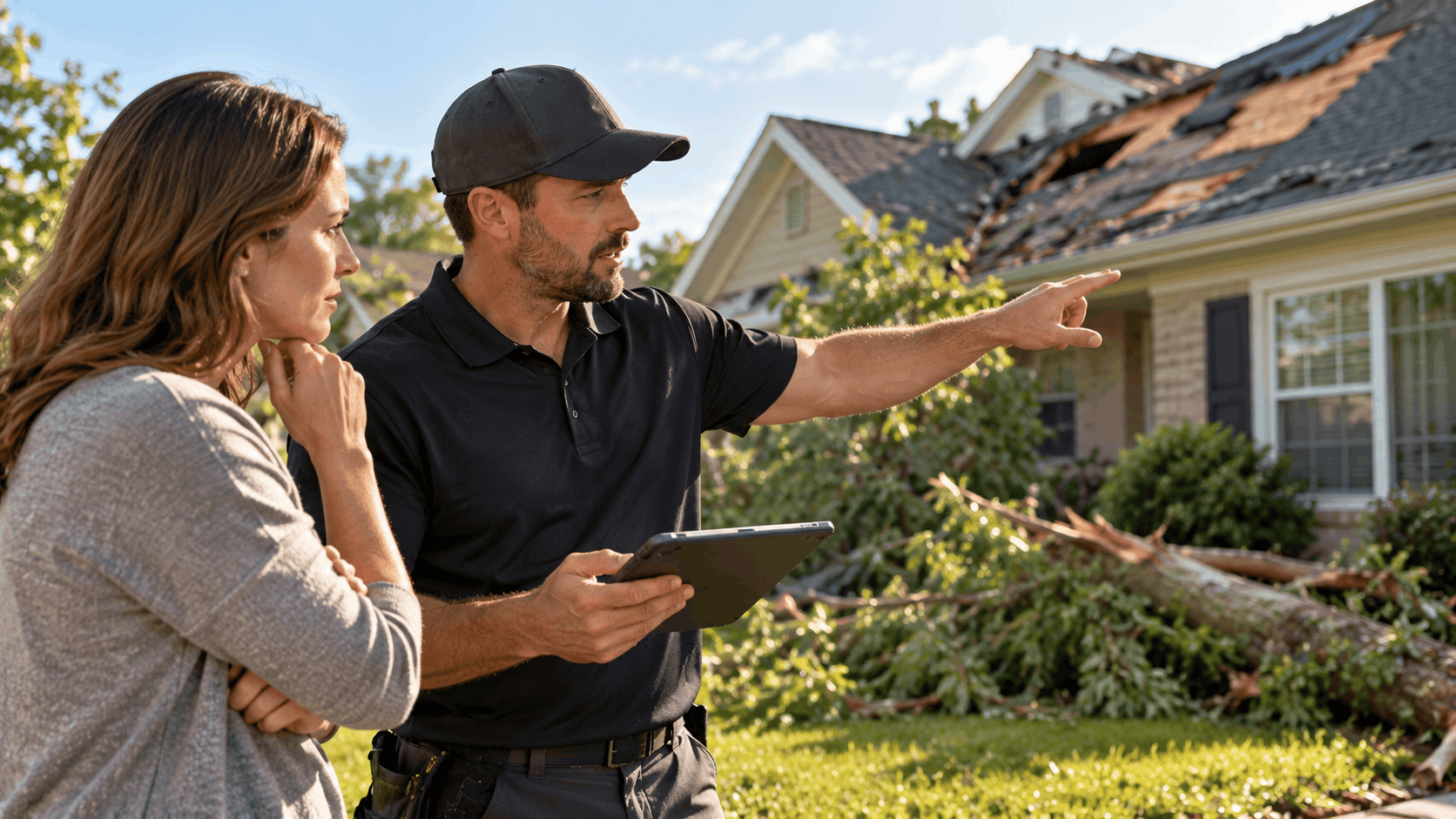
A hail storm rolls through a neighborhood on a Tuesday afternoon. Within an hour, a dozen homeowners are standing in their yards looking at dented gutters and scattered shingles, and most of them do the same thing. They pull out their phones and fill out contact forms on three or four roofing websites at once.
Here is the short answer to why the first hour decides the job. Storm-hit homeowners contact several roofers at the same time, and the one who calls back first usually books the inspection. Speed, not the biggest ad budget, often wins the work. A roofer who answers in the first hour is talking to a homeowner before the competition has even seen the form.
Why the First Hour Decides a Storm Roofing Job?
Lead response time is one of the clearest advantages a roofer can win on, and it costs nothing but attention. The core idea is simple. The faster a company reaches a web lead, the more likely that lead turns into a real conversation. For storm work, where a homeowner is anxious and shopping fast, the first hour matters even more than it does for a planned reroof.
Most roofing owners already sense this, but the research puts hard numbers behind it. A fast callback is not just polite. It is the difference between booking an inspection and finding out the homeowner already signed with someone else. Below we break down what the data shows and why storm leads cool off faster than any other kind of roofing inquiry.
What the Research Says About Replying Within an Hour
The most cited study on lead speed comes from Harvard Business Review. SmartCompany reported on it in July 2011, covering research that sent a web test lead to 2,241 US companies and also reviewed 1.25 million leads. The finding roofers should remember is direct and specific.
Firms that tried to contact a web lead within an hour were nearly seven times as likely to qualify that lead as firms that waited one hour longer. To qualify a lead means having a real conversation with a decision maker, the step that comes before booking an inspection or closing a job. Seven times is not a small edge. It is the gap between a healthy pipeline and a dead one.
That number holds across industries, which is why it applies cleanly to roofing. A homeowner who just filled out a form is sitting at their computer, phone in hand, thinking about their roof right now. Reach them in that window and the conversation flows. Wait, and their attention has already moved on to the next quote.
The lesson is not complicated, but acting on it takes a real system. Knowing that the first hour is worth seven times more should change how a roofer staffs the phones, especially during storm season when leads arrive in clusters rather than one at a time.
How Many Companies Actually Respond Fast
Here is the part that should encourage any roofer willing to move quickly. The same 2011 Harvard Business Review research, as reported by SmartCompany, found that only 37% of the 2,241 companies tested responded to a web lead within an hour. That means most businesses are slow, and slow is a weakness a fast roofer can exploit.
It gets worse for the slow crowd. The study found that 23% of companies never responded at all. Among the firms that did reply within 30 days, the average response time was 42 hours. And 24% of companies took more than a full day to make contact.
Sit with those numbers for a second. Nearly a quarter of businesses never call back, and the average reply takes almost two days. A homeowner with a damaged roof is not waiting two days. By then they have already met with another roofer and may have signed.
This is the gap a fast roofer wins on. A company does not need the slickest website or the biggest budget to beat a competitor who takes 42 hours to call back. It simply needs someone watching the leads and willing to pick up the phone while the homeowner still cares. Speed is the cheapest competitive advantage in the trade.
Why Storm Leads Go Cold Faster Than Normal Roofing Leads
Normal roofing leads give a roofer a little breathing room. Someone planning a reroof next spring is often comparing options slowly. Storm leads are different, because the homeowner is dealing with active damage and a shrinking window of patience.
After a hail or wind event, many homeowners submit contact forms to several roofers in the same afternoon. They are scared about leaks, worried about their insurance claim, and want someone on the roof fast. The first roofer to call back often books the inspection simply by being first in line. The second and third callbacks are talking to a homeowner who already has an appointment set.
The urgency is backed by survey data. A This Old House survey in 2026 of 1,000 homeowners found that weather damage was the top reason for a roof replacement at 40%. Nearly 57% of those homeowners described the project as urgent or an emergency. That is the mindset a roofer is calling into after a storm.
When more than half of storm-hit homeowners treat the job as an emergency, a 42-hour response time is not just slow. It is invisible. The homeowner called an emergency, and the roofer answered two days later. Storm leads reward the company that treats the first hour as the whole ballgame, because to the homeowner, it is.
What a Storm Lead Is Really Worth?
Speed matters more once a roofer sees the dollars attached to each lead. A storm roofing job is not a small ticket. When a slow callback loses one, the roofer loses both the money spent to get the lead and the revenue the job would have brought in. Put those together and a missed first hour has a real price tag.
This section lays out three numbers: what a roofing customer is worth, what it costs to win a lead, and why a missed callback stings more than the lead fee alone. Understanding the math makes the case for a follow up system on its own.
The Dollar Value of a Roofing Customer
Roofing jobs sit at the high end of home services, which is exactly why each lead deserves a fast response. According to Angi data reported by NerdWallet in September 2025, a roof replacement averages about $9,500, with a range running from roughly $5,800 to $46,000 depending on size, material and pitch. These are typical ranges, not quotes, but they show the scale of a single job.
Repairs are smaller but still meaningful. HomeAdvisor data from June 2026 put the average roof repair at about $1,174, with a typical range of $395 to $1,967. A homeowner who calls for a repair after a storm may also turn into a replacement once the roof is inspected, so even a smaller lead can grow.
Insurance claim figures run higher. Verisk reported 2025 claim averages of $17,631 for a replacement, up 33% versus the 2021 to 2024 average, and $4,699 for a repair, up 25%. Storm work often runs through a claim, so those numbers reflect what a lot of post-hail jobs actually settle at.
Whatever figure a roofer uses, the point holds. A single storm lead can be worth thousands of dollars in revenue. That value is the real reason the first hour deserves a system, not a hope that someone happens to be near the phone.
What Roofing Leads Cost to Win
Leads are not free, and roofing leads are among the most expensive in all of home services. LocaliQ's home services benchmarks, drawn from 3,211 US campaigns between April 2024 and March 2025 and reported in July 2026, found a median cost per lead of $228.15 for roofing and gutters. That was the highest cost per lead of all 16 home services categories LocaliQ measured.
Other vendor data lands lower but still real. 99 Calls data reported by Lead Smart Inc in September 2026, drawn from that vendor's own Local Services Ads campaigns, put the 2026 average cost per charged lead at $106.87 for roofing. Both of these figures come from each source's own campaign data, so a given market may run higher or lower.
Either way, a roofer is paying real money for every form that comes in. Whether a lead costs $107 or $228, that money is already spent by the time the phone rings. The question is only whether the roofer converts it.
These acquisition costs reframe the whole conversation about speed. A roofer who ignores a lead for 42 hours has still paid for it. The money left the bank account regardless of whether anyone called the homeowner back.
Why a Missed Callback Costs More Than the Lead Fee
Now put the two numbers side by side. A roofer pays somewhere around $107 to $228 for a storm lead, and that lead could become a job worth thousands. A slow first hour does not just risk the lead fee. It risks the entire job.
Think of it as paying twice to lose. First, the roofer spends the lead fee to get the homeowner's information. Then, by calling back too slowly, the roofer hands the actual job, and all its revenue, to a competitor who answered faster. The lead fee is gone and the job is gone with it.
This is why a missed callback costs far more than the line item on an ad invoice suggests. The real cost is the lost replacement or repair, not the $107 lead charge. A roofer who treats leads as cheap because the fee feels small is quietly throwing away jobs worth twenty to a hundred times that fee.
None of this is a promise about any particular outcome. It is reasoning about math. When the lead costs real money and the job is worth thousands, the first hour of follow up is where that math gets decided.
DM. Digital helps local service businesses dominate Google with custom-built websites.
When Storm Leads Spike and How to Staff for It?
Storm leads do not arrive evenly across the year. They come in surges tied to the weather, which means a roofer who plans follow up capacity before the surge beats one who scrambles during it. Hail season and spring storm patterns are predictable enough to staff around.
This section covers when the leads spike, the losses behind the call volume, and why a busy crew can still lose new work if follow up is not handled separately from field capacity.
The Hail Calendar Drives the Lead Surge
Hail is the engine behind most storm roofing leads, and it follows a calendar. NOAA's National Centers for Environmental Information reported that in 2025, hail reports peaked in May at 30.8% of the year's total. The April to June window accounted for nearly two-thirds of all hail reports for the year.
That spring concentration matters for staffing. Roughly two out of every three hail events land in a three-month window, which means lead volume spikes hard in spring and early summer. A roofer who wants to catch those leads in the first hour needs the phones covered heaviest during exactly those months.
Insurance data tells the same story. Farmers Insurance reported in May 2026 that from January 2024 through March 2026, hail made up about 31% of its homeowners claim volume, with a seasonal increase in hail-related losses during spring. When hail claims climb in spring, roofing leads climb right alongside them.
The practical takeaway is to plan ahead. A roofer who waits until the first May hail storm to think about follow up coverage is already behind. The calendar is public, so the capacity to answer fast can be arranged before the surge, not during the chaos of it. You can learn more about local search strategy that brings those leads in before the season hits.
Storm Losses Behind the Call Volume
The reason phones ring after a storm is simple. The damage is enormous and widespread. Severe convective storms, the category that includes hail and wind, caused $51 billion of US insured losses in 2025 according to Gallagher Re data via Triple-I. Hail drives about 80% of those claims.
That scale explains the clustering of leads. When a single storm damages hundreds of roofs across a few neighborhoods, every one of those homeowners becomes a potential customer in the same window. The roofer is not competing for one lead at a time. They are competing for a whole street at once.
There is also a large base of roofs already in poor shape waiting to be pushed over the edge. Verisk reported in May 2026 that 38% of homes show moderate to poor roof condition. A hail event that might only ding a new roof can total an aging one, which turns more storm leads into full replacements.
For a roofer, this means storm demand is both deep and bunpredictable in timing. The losses are there, the aging roofs are there, and a single storm can convert both into a flood of leads overnight. The company ready to answer those leads fast is the one positioned to capture the work.
Why Backlog Makes Fast Follow Up Harder
Here is a trap that catches busy roofers. When crews are slammed, follow up often slips, because everyone assumes there is no room for more work anyway. That assumption loses jobs. The NRCA reroofing index for Q2 2026 showed that 30% of contractors had no backlog at all, while 13% had five or more months of work lined up.
That spread tells an honest story. Some roofers are hungry for work while others are buried. But even a buried roofer should not stop answering leads, because follow up and crew capacity are two separate problems that need separate solutions.
A busy crew can finish its backlog and need the next job in three weeks. If nobody answered the leads that came in during the busy stretch, there is nothing in the pipeline when the crew frees up. The homeowners who called are long gone, booked with someone who picked up the phone.
The fix is to treat intake as its own job. The person watching the leads in the first hour does not have to be on a roof. They just have to call back, book the inspection and keep the pipeline full so the crew always has work waiting. Separating follow up from field capacity keeps a roofer from feast-and-famine cycles.
Building a First-Hour Follow Up System
Knowing the first hour matters is one thing. Building a system that actually delivers a human reply in that window is another. The good news is that the pieces are simple and do not require expensive software. They require routing, scripts and a bit of discipline.
Here is a practical setup any roofer can put in place before the next storm. This is general advice, not a service performed on the roofer's behalf.
Send Leads Straight to a Phone Someone Watches
The first rule is that a lead cannot be answered if nobody sees it. Website form submissions and Google Business Profile messages should route straight to a phone or inbox that a real person watches during storm windows. Storms do not keep business hours, so that coverage has to include evenings and weekends when hail tends to hit.
Many roofers lose leads simply because the form notification lands in an email nobody checks until the next morning. By then the first hour is long gone. Setting up an instant alert to a cell phone, so a person feels the buzz the moment a lead arrives, closes that gap. It is the single most useful change a slow roofer can make.
The leads themselves should always flow to the owner's own business email, so the roofer owns the pipeline. That matters because the business keeps receiving those inquiries no matter what else changes. A roofer who controls their own lead inbox never has to worry about losing access to their customers.
Routing is the foundation everything else sits on. A perfect call script is useless if the lead never reaches a human. Get the alerts flowing to a watched phone first, then build the response around it. A well-built lead-focused website makes sure those forms reach you the moment they are filled out.
Script the First Call and the First Text
Once a lead reaches a person, the goal of the first call is narrow. Book the inspection. A short opening script keeps the call focused and calm. The roofer confirms the address, acknowledges the storm damage, and offers the earliest inspection time available. Keeping it simple stops the call from wandering and gets the appointment on the calendar.
Pairing the call with an automated acknowledgment text covers the moments when a homeowner does not pick up. A quick message letting them know a real person is calling and an inspection is being scheduled tells the homeowner they are not shouting into the void. That small reassurance can be the difference between keeping the lead warm and losing it to the next roofer.
Both touches work together. The call books the job and the text confirms a human is on the way. Many homeowners after a storm are getting calls from several roofers, so a clear, professional first contact helps a company stand out from the pushy door knockers.
If a roofer wants to measure how fast and how often these calls connect, call tracking is a tool an owner can set up independently. Tracking phone numbers and call records can show response times and which lead sources convert. This is general advice an owner can arrange on their own; it is a measurement tool, not part of the follow up itself.
Keep Following Up After the First Hour
The first hour is the priority, but it is not the end. Many storm leads will not answer the first call, because the homeowner is on the phone with their insurer, another roofer, or simply overwhelmed. A simple follow up sequence over the first few days catches those leads without crossing into harassment.
A sensible sequence might be a call and text in the first hour, another attempt later that day, and a couple more touches spread across the following days. The goal is persistence, not pestering. A homeowner juggling a stressful claim often appreciates a roofer who checks back politely rather than disappearing after one missed call.
The reason persistence pays is that homeowners are comparing options. The Owens Corning and Roofing Contractor survey found that 66% of homeowners get three quotes. That means most storm leads are talking to at least two other roofers, and the company that stays in respectful contact is the one still in the running when the homeowner decides.
A short, planned sequence beats relying on memory during a busy season. When leads are pouring in, the roofer who scribbled a note to call back later will forget. The one with a set sequence catches the homeowner who answers on the third try instead of the first.
DM. Digital helps local service businesses dominate Google with custom-built websites.
Why Storm Leads Find You Before You Call Them?
A follow up system only works if leads actually arrive. Fast callbacks mean nothing if the form never gets filled out. So the other half of the equation is visibility: being the roofer a storm-hit homeowner finds when they start searching. This section covers how homeowners look, where they look, and which profiles feed the search and AI tools they use.
How Homeowners Look for a Roofer After a Storm
Homeowners do not all find roofers the same way, so a company needs to show up in more than one place. The Owens Corning and Roofing Contractor survey, published in May 2026, found that 74% of homeowners follow a referral when choosing a roofer. Referrals remain the single strongest channel, which means doing good work and staying memorable pays off for years.
Search engines come next. The same survey found exactly half of homeowners use search engines to find a roofer, and about a quarter use home services websites. That means a strong online presence reaches the half of the market that is not working from a personal referral, which is a large pool after a widespread storm.
Reviews shape the decision heavily once a homeowner finds a name. BrightLocal's 2026 research found that 97% of consumers read reviews when choosing a local business. A roofer with recent, positive reviews and thoughtful replies looks far more trustworthy than one with a stale or empty profile.
AI tools are now part of the mix too. BrightLocal found that 45% of consumers have used AI tools to find local businesses. That share is a reason to make sure a roofer's information is accurate everywhere those tools pull from, which we cover below. A healthy review generation and response routine supports every one of these channels at once.
Why Near Me Searches Run Through the Map Pack
When a homeowner types a hiring search like roofer near me, the result is usually a map. An Ahrefs check of six roofing searches in October 2026 found a Google map pack appeared on five of the six. Neither of the two near me searches in that check showed an AI Overview at all. That is a dated observation and results vary by location, but the pattern is clear and consistent with how local hiring searches behave.
What that means for a roofer is that the map pack is where hiring decisions get made. Those three local listings sit above the regular results and grab most of the clicks for near me and city-based searches. A roofer who is not in that map pack is largely invisible for the exact searches that signal someone ready to hire.
The map pack rests on three things Google weighs: relevance, distance and prominence. Relevance is how well a profile matches the search, distance is how close the business is to the searcher, and prominence is how well known and well reviewed the business is. A roofer influences relevance and prominence directly through their Google Business Profile and map pack optimization.
Because near me searches skip the AI answers and go straight to the map, Google Business Profile work is where hiring visibility is won. Categories, services, service areas, photos and reviews all feed the signals Google uses to decide which three roofers appear. Getting that profile right is the groundwork that lets a follow up system have leads to answer.
Where AI Answers Show Up for Roofing Questions
AI answers do appear for roofing, just not usually for hiring searches. They show up on research questions. WebFX analyzed 237,990 US home services queries in a July 2025 snapshot and found AI Overviews appeared on 17.7% of home services searches overall. For longer queries of seven or more words, AI Overviews appeared 41.1% of the time.
That split tells a roofer exactly where to focus content. Long, detailed questions, the kind someone types when researching cost, process or insurance, are where AI answers show most. The Ahrefs October 2026 check lined up with this, finding AI Overviews on queries like roof replacement cost and roof inspection, but not on the near me searches.
So a homeowner asking how much a roof replacement costs after hail, or how a roof insurance claim works, is likely to get an AI answer. A roofer whose website clearly answers those questions gives the AI something specific to cite. That is how a company earns a place in those answers, by being genuinely useful on the exact topics homeowners research.
This is where AI search visibility, built through generative engine optimization and answer engine optimization, comes in. Pages that answer cost, timing and claim questions clearly and specifically are the ones AI tools pull from. We cannot promise placement in any AI answer, but clear, well-organized AI visibility content gives these tools something worth citing.
The Profiles AI Tools and Search Pull From
Both search engines and AI tools draw their local recommendations from a predictable set of sources, and most of them are ones a roofer can control. BrightLocal's August 2026 research on service business citations found google.com accounted for 45% of citations, yelp.com 12.3%, facebook.com 4.4%, bbb.org 1.6%, and angieslist.com 1.4%. Google Business Profile is far and away the biggest source.
The encouraging part is how much of this a roofer can shape directly. Yext's October 2025 study of 6.8 million citations found that 86% of citations came from brand-owned or brand-managed sources, meaning websites and listings the business controls. These are not mysterious third-party rankings. They are profiles a roofer can make accurate and consistent.
The practical steps follow from the data. Keep the Google Business Profile accurate and complete, maintain a real Yelp presence, and make sure directory listings like BBB and Angi carry the same name, address and phone number. Consistency across those profiles helps both search and AI tools trust and cite the business.
None of this guarantees a citation or a ranking. What it does is put a roofer's accurate information in front of the sources these tools actually use. A company with sloppy, inconsistent listings gives AI tools reasons to skip it. One with clean, consistent profiles and steady reviews gives them something solid to pull from. Strong citation management keeps those profiles aligned across the web.
Staying Compliant While You Chase Storm Leads
Fast follow up should never slide into sloppy or illegal messaging. Storm roofing is a market full of advertising and claim rules, and breaking them brings fines and lost trust. The rules vary by state, so a roofer should confirm the current requirements with their own state. What follows is general information, not legal advice.
Deductible and Claim Promises That Get Roofers Fined
The most common way roofers get into trouble is offering to handle a homeowner's deductible. Several states bar this outright. In Texas, the Business and Commerce Code 27.02 prohibits a roofer from waiving or rebating an insurance deductible. Colorado's C.R.S. 6-22-105 similarly bars roofing contractors from paying, waiving or rebating a deductible or acting as a public adjuster.
Florida goes further with penalties. Florida statute 489.147 bans rebates, gift cards, deductible waivers or anything of value offered for an inspection or claim. Violations can bring fines up to $10,000 per violation. Claim-encouraging ads in Florida also need disclosures in a minimum font size.
These rules trip up roofers who mean well. An offer like we pay your deductible or free roof sounds generous but is illegal in these states. A follow up text promising to cover the deductible is not just bad practice, it can bring real fines.
Because these rules differ by state and change over time, a roofer should confirm the current requirements with their state before building any claim-related messaging. The safe path is to keep follow up focused on the inspection and honest service, not deductible promises.
Putting Your License Number in Every Message
Some states require a roofer's license number to appear in all advertising, and that requirement reaches further than many owners expect. Florida statute 489.119 requires the license number in advertising regardless of medium. California also requires the license number in all advertising, with a first-offense penalty running from $100 to $1,000.
The part roofers miss is what counts as advertising. Follow up texts and emails that promote the business can count. That means the automated acknowledgment text and the follow up emails in a sequence may need to carry the license number in states that require it. A fast follow up system that forgets this detail can create a compliance problem at scale.
Building the license number into message templates from the start solves the issue cleanly. Rather than remembering to add it each time, a roofer can set it as a standing part of every outbound message. That keeps speed and compliance working together instead of against each other.
Requirements differ by state and by advertising medium, so a roofer should confirm with their state licensing board exactly where the license number must appear. Getting this right protects a company from penalties that have nothing to do with the quality of its roofing work.
Reviews and Trust in a Storm Chaser Market
Storm markets attract out-of-town operators who damage trust for everyone, so an established roofer has to work to look legitimate. The National Insurance Crime Bureau reported that contractor fraud reports rose 38% from 2023 to 2025. Common red flags include post-storm door knocking, deductible waiver offers and cash demands. A local roofer who avoids all three stands apart from the storm chasers.
Reviews are central to earning trust, and they come with their own rules. The FTC Consumer Review Rule, effective October 21, 2024, bans fake reviews, including ones written by AI. It also bans incentives tied to a particular sentiment, undisclosed insider reviews and review suppression. A roofer building a review base must do it honestly, with real customers and no strings attached to the rating.
The trust signals a homeowner looks for have also changed on Google. On October 20, 2025, Google combined its older Google Guaranteed, Google Screened and License Verified badges into a single Google Verified badge. The older money-back guarantee was discontinued. A roofer using outdated Google Guaranteed wording in ads or on a website looks out of date and should update it.
Put together, these rules point to one approach. Be the opposite of a storm chaser: local, licensed, honestly reviewed and clearly identified. In a market where fraud reports are climbing, the roofer who looks and acts legitimate has a real edge with cautious homeowners.
DM. Digital helps local service businesses dominate Google with custom-built websites.
How DM. Digital Helps Roofers Capture Storm Leads
Fast follow up depends on leads arriving in the first place, and that takes a visibility and intake foundation built before the storm season. DM. Digital is an SEO agency that helps roofers across the United States get found on Google Search, Google Maps and AI tools, then capture the leads that visibility produces. Here is how that works in practice.
A Website and Profile Built to Bring Leads In
DM. Digital works through one monthly package rather than one-off projects. That package covers a custom website build and ongoing management, Google Business Profile management with weekly posts, content production, backlinks, citations and press releases. Together these build the search and map visibility that puts a roofer in front of storm-hit homeowners.
The Google Business Profile work matters most for hiring searches, since that is what feeds the map pack. Weekly posts, accurate categories and services, and a steady presence keep the profile active and relevant. The website is built on a custom platform and tuned to turn visitors into form submissions.
Importantly, the roofer keeps control of their own assets. Leads from the website go straight to the owner's own business email, so the company owns its pipeline. The client keeps their domain, their Google Business Profile and their accounts. If the engagement ever ends, the roofer keeps everything built and keeps receiving leads.
This structure means the visibility foundation and the intake point are built together. The profile and website bring leads in, and those leads land in an inbox the roofer controls and watches, ready for the first-hour follow up the earlier sections describe.
Content That Answers Cost and Claim Questions
The research questions homeowners type after a storm are where AI answers and informational search traffic show up. DM. Digital's content management runs across SEO, generative engine optimization and answer engine optimization, so those long cost, timing and insurance questions get clear pages that search engines and AI tools can draw from.
A roofer whose site thoroughly answers how a roof insurance claim works, what a replacement costs after hail, or how long an inspection takes gives these tools something specific to cite. As the WebFX data showed, long detailed questions are exactly where AI Overviews appear most, so content built around them targets the right moments.
That content also serves the homeowner directly. Someone comparing three quotes and reading up on the process is more likely to trust and call a roofer whose website already answered their questions clearly. Good content works for both the searcher and the AI tool at once.
We cannot promise a particular ranking or a spot in any AI answer. What we can do is build pages worth citing, organized around the real questions homeowners ask, through ongoing content strategy and production.
Reporting That Tracks Leads and Visibility
A roofer should be able to see what the work produces. DM. Digital provides monthly reports covering leads, traffic, domain rating, backlink totals and AI mentions. While an engagement is active, clients also get a live lead dashboard so they can watch inquiries come in.
The reporting is built on leads, because leads are what grow a roofing business. Tracking domain rating and backlink totals shows how the site's authority is building over time, and AI mentions show where the business is starting to appear in AI answers. Together these give a clear picture of visibility and results.
One thing to be clear about: DM. Digital does not provide call tracking. The tracking phone numbers and call recording a roofer might use to measure response speed are something an owner sets up independently. DM. Digital's reporting is lead-based, covering the inquiries that reach the business.
That reporting ties the whole effort together. A roofer can see visibility climbing, leads arriving and AI mentions growing, all in one place, through analytics and performance reporting that focuses on the numbers that move a business.
How an Engagement Works
Getting started is straightforward. A prospect calls or leaves a message, and Dan Milstein, who founded DM. Digital and has been doing SEO since 2018, calls back. They have a conversation, Dan runs an audit of the roofer's current visibility, and then he sends a proposal.
Engagements start at a budget of $5,000 per month and grow from there based on the plan. The roofer pays one monthly fee that covers the website, Google Business Profile management, content, backlinks, citations and press releases, and never pays separate vendors. There is intentionally no pricing page, because the right budget comes out of the audit and the conversation.
There is no minimum commitment. Either side can end the engagement with 30 days notice. If a roofer decides to stop, they keep their domain, their Google Business Profile, their accounts and everything built, and leads keep flowing to their own business email.
That structure is built for roofers who want visibility handled while they run crews. The foundation gets built, the leads come in, and the roofer focuses on the first-hour follow up that turns those leads into booked jobs. You can reach out through the contact page to start that conversation.
Answer Fast and Build the Visibility That Feeds the Phone
The first hour decides storm roofing jobs because homeowners call several roofers at once and reward the one who answers first, while leads this valuable deserve a system, not a hope. To talk through building the visibility and intake that fast follow up depends on, call DM. Digital at (775) 843-8004 or leave a message, and Dan will call back, run an audit of your current visibility, and send a proposal built around your market.